
IXOPAY and Zip US Introduce Unified Trust Layer Framework to Help Merchants Reduce Risk in Agentic Commerce
Open, Collaborative Initiative to Establish Identity, Preserve Intent, and Make Trust Measurable in AI-Initiated Commerce
LEHI, UT AND NEW YORK, NY / ACCESS Newswire / March 24, 2026 / IXOPAY, the enterprise-grade global payment infrastructure platform built for the era of agentic commerce, and Zip, the digital financial services company offering innovative, people-centred products, today announced a joint initiative to define a Unified Trust Layer - an open industry framework designed to address emerging trust and liability challenges in agent-initiated commerce and payments.
Agentic commerce introduces a structural shift in payments. Traditional infrastructure was built around a four-party risk model - consumer, merchant, issuing bank, and acquiring bank - with the assumption that a human initiated the transaction. As AI agents begin acting autonomously, that model no longer holds. Payment systems were not designed to consistently preserve identity, intent, and context in a machine-verifiable way, leaving merchants to bear the burden of authentication without the benefit of fraud filters, security protocols or shared liability with issuers.
With this risk shifting downstream, merchants will face increased chargebacks, elevated false declines due to fraud systems misclassifying legitimate agents, and reduced visibility into customer relationships as agents intermediate the experience. Industry leaders recognize the urgency: According to a recent Accenture study, 87% of financial institution chief technology officers and payments heads believe trust will be the most significant barrier to agentic payments adoption, and 78% expect fraud to increase significantly as agentic commerce scales.
The Unified Trust Layer Framework
Confronting this structural shift head-on, IXOPAY and Zip are developing a Unified Trust Layer framework, an open industry initiative that embeds transparency, auditability, and interoperability into agent-driven transactions, setting a new standard for trust in agentic commerce. The framework seeks to aggregate and orchestrate trust signals across providers, networks, and protocols while preserving merchant-owned, portable trust artifacts.
"Payments infrastructure wasn't built for autonomous actors," said Jill Willard, Chief Technology Officer at IXOPAY. "When AI agents initiate transactions, merchants still carry the liability, but the system doesn't consistently preserve identity and intent in a defensible way. At IXOPAY, we view tokenization and orchestration as programmable trust infrastructure, giving merchants control, portability, and auditability across fragmented ecosystems. This initiative is about extending that integrated foundation to agentic commerce."
"Traditional fraud models rely heavily on static credentials," said Rory Herriman, Chief Technology and Operations Officer at Zip. "But agents aren't people, and their risk doesn't show up the same way. We've connected millions of consumers with tens of thousands of merchants through our ability to establish trust using behavioral and contextual signals. As machines begin transacting on behalf of humans, that same discipline needs to be applied to agent behavior. This framework is about making trust measurable and explainable in a system that was never built for it."
From Payment Orchestration to Trust Orchestration
In an agentic environment, orchestration evolves from routing transactions to managing tokenized trust across protocols and providers. The proposed Unified Trust Layer centers on three capabilities:
Agent Identity Validation: Normalizing identity verification and behavior patterns across fragmented agentic protocols.
Intent Capture and Preservation: Binding explicit human consent and transaction context into an immutable, replayable record.
Contextual Trust Signaling: Aggregating agent behavioral signals across providers, networks, and protocols to support informed authorization decisions and strengthen dispute defensibility.
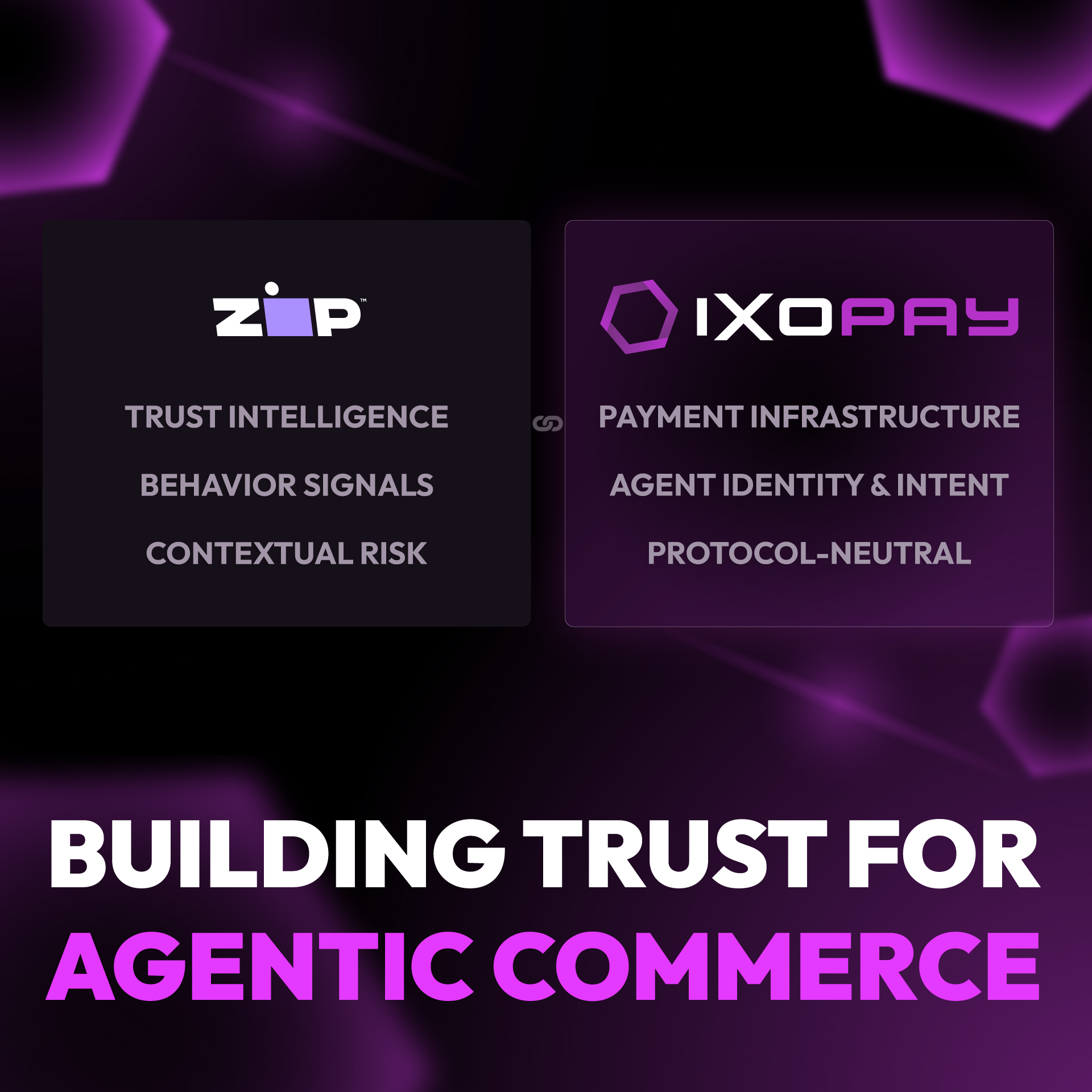
Together, IXOPAY and Zip combine merchant-owned, provider-agnostic tokenization with real-time behavioral intelligence.
Open and Collaborative
The Unified Trust Layer is an open framework in development. IXOPAY and Zip invite merchants, networks, platforms, and ecosystem participants to help shape how identity, intent, and trust should function in agentic commerce.
Learn more about the framework, and how to participate at our upcoming webinar on April 8, 2026: https://www.ixopay.com/unified-trust
Media Contact:
Tony Hynes
Verdis
[email protected]
About IXOPAY
IXOPAY is the enterprise-grade global payment infrastructure platform built for the era of agentic commerce, equipping merchants and businesses with AI-driven intelligence, orchestration, advanced tokenization, and the tools to power every step of their payments journey. From routing and compliance to customized modules and full-scale orchestration, IXOPAY delivers the infrastructure for faster integrations, higher approval rates, and seamless global expansion. Learn more at www.ixopay.com.
About Zip
Zip Co Limited is a digital financial services company, offering innovative and people-centred products. Operating in two core markets - Australia and New Zealand (ANZ) and the United States (US), Zip offers access to point-of-sale credit and digital payment services, connecting millions of customers with its global network of tens of thousands of merchants.
Founded in Australia in 2013, Zip provides fair, flexible and transparent payment options, helping customers to take control of their financial future and helping merchants to grow their businesses.
For more information, visit www.zip.co.
SOURCE: IXOPAY
View the original press release on ACCESS Newswire
W.Widmer--HHA