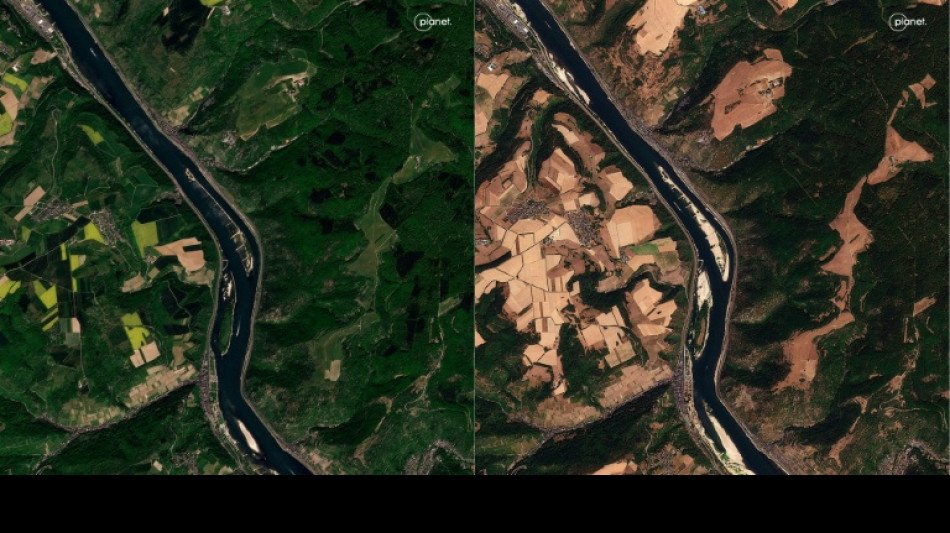
Europe swelters under fresh wave of extreme heat / Photo: - - 2026 Planet Labs PBC/AFP
Millions of people across Europe -- particularly in France, Italy, Spain and Britain -- baked through a new wave of extreme temperatures Thursday as the continent's latest heatwave picked up.
More than 135 million people were forecast to face temperatures above 35C, with Britain recording its fifth-hottest day on record and parts of France soaring past 42C.
"The heat has been unbearable here, honestly," said pharmacist Bailey Williamson, voicing concern for hospital patients as Britain sweltered.
Europe is the fastest-warming continent and in some places is ill-equipped to deal with hot weather. Scientists blame ever hotter and more frequent heatwaves on human-caused climate change.
Repeat heatwaves and drought have fuelled a historically hot summer of wildfires, and contributed to the deaths of thousands of people.
Temperatures were to surpass 30C for nearly three out of five European residents (excluding Turkey) -- around 340 million people -- according to an AFP analysis based on German weather service forecasts and 2025 population projections from the Joint Research Centre.
The findings are consistent with those of Austrian NGO Klimadashboard.
- Patients suffering in UK -
In London, temperatures hit 38.1C at Kew Gardens, making it the fifth-hottest day on record for Britain, according to official weather agency the Met Office.
Williamson, 20, who works for the National Health Service (NHS), said the heat was hitting hospital patients hard.
"People in beds are really, really sick, and they can't even breathe because of the heat problem -- so it's really bad," he said.
Hospitals had recorded an increase in heat stroke cases, and the NHS was struggling to keep up, he added.
"It's scary," Williamson said of the heatwaves. "I think it's a real sign about how bad climate change has really got."
Tim Wallace, 60, visiting from Australia, was also struck by the heat.
"I've never seen it like this, and it's clearly, it is concerning," he said.
"We might have summers like this more often, and the grass will burn off more often, and it'll come back. But it's all part of the planet getting hotter."
- Europe swelters -
In France, temperatures climbed even higher, with weather service Meteo-France recording 42.5C in Chateaumeillant in central France, the country's highest reading on Thursday.
Paris hit 38C and much of the country was under a heatwave alert.
In Italy, similar temperatures were forecast to affect 29 million people, particularly along the west coast, in the Po Valley, the south and on Italy's islands.
Large parts of the Iberian Peninsula also sweltered, with around 25 million people affected in Spain. The country's Aemet weather agency recorded temperatures of 37C in central regions on Thursday.
In the UK, temperatures also reached 36C or higher in 40 locations across central and southern England. The country is on track to record its hottest ever summer, the Met Office said this week.
The heatwave has fanned wildfires across Europe. In northern Greece, hundreds of tourists were evacuated by boat as a forest fire bore down on two popular resorts, while crews in central England's West Midlands region battled blazes damaging homes amid drought conditions.
AFP calculates the figures using a method similar to that of Klimadashboard, cross-referencing population density with the weather forecast model from the Deutscher Wetterdienst (DWD) -- Germany's national meteorological service -- published at 0300 GMT.
Residents are counted if the model forecasts temperatures above 30C or 35C at their location at any point during the day.
As the model has a resolution of approximately 6.5 km it does not fully capture urban heat-island effects, when cities are significantly warmer than surrounding rural areas, David Jablonski of NGO Klimadashboard told AFP.
burs-rh/tw
M.Schneider--HHA