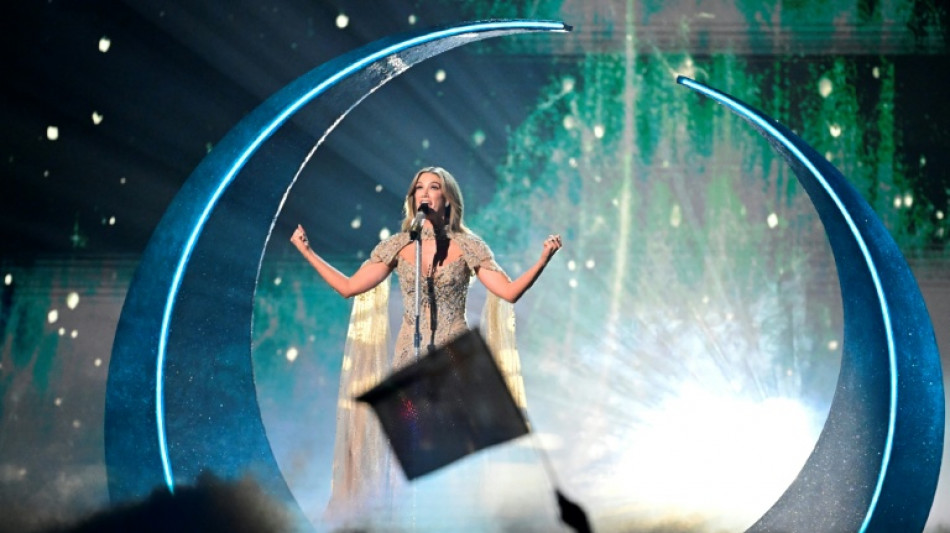
Romanian metal, Aussie star through to Eurovision final / Photo: Tobias SCHWARZ - AFP
Romanian metal, a Danish ode to clubbing and Australian star Delta Goodrem will fill the airwaves in the Eurovision grand final after making it though the second semi-final on Thursday.
Contestants from 15 countries sang their hearts out in the Austrian capital to try to secure the last 10 places in Saturday's showpiece extravaganza at the Wiener Stadthalle.
Besides Australia, Denmark and Romania, which bookmakers place among the front-runners, Albania, Bulgaria, Cyprus, the Czech Republic, Malta, Norway, and Ukraine live to fight another day.
But it was Goodnight Vienna for Armenia, Azerbaijan, Latvia, Luxembourg and Switzerland, who saw their Eurovision dreams crumble.
While waiting for the nerve-shredding reveal of the results, the crowd danced a mass Viennese waltz.
Eurovision is the world's biggest live televised music event, typically reaching more than 150 million viewers, and Vienna 2026 is the 70th edition of the glitzy show where spectacle and drama go hand in hand.
- Going off with a 'Bangaranga' -
Thursday's concert saw Switzerland's Veronica Fusaro tangled up in red webbing, Londoner Antigoni singing the sultry "Jalla" for Cyprus and Ukraine's Leleka hitting some ear-shredding high notes.
Bulgarian pop singer Dara got the party started with some high-energy and highly choreographed dancing on "Bangaranga".
Filmed in close-up, the Czech Republic's Daniel Zizka sang "Crossroads" in a hall of mirrors that began swirling like a zoetrope.
Armenia's Simon worked up a sweat on "Paloma Rumba", a song about a man "stuck on a wage / In a rage" who breaks free, starting off being trapped in a lift in a jacket covered in yellow sticky notes.
Romania swung the show into heavy rock on "Choke Me", which caused a minor furore in the Eurovision build-up over the lyrics.
However, singer Alexandra Capitanescu, a master's student at the Faculty of Physics in Bucharest, defended the song.
"Unlike the classic heart, which represents romance or cute love, the anatomical heart suggests vulnerability... and emotions that feel intense, physical and almost painful," she insisted.
- Mother love -
There were quieter moments too: Latvia's Atvara sang the gentle "Ena" seemingly in a swirl of broken glass.
Meanwhile, Albania's Alis sang his song "Nan", about missing one's mother, ending with a maternal figure appearing on stage, briefly touching his face as he sang: "Worry not / Mother will be waiting for you."
Denmark's Soren Torpegaard Lund, whose background is in musical theatre, is gaining traction with "For Vi Gar Hjem" ("Before We Go Home"), plunging viewers into the world of nightclubs.
Australia has appeared at Eurovision by invitation since 2015, finishing runner-up in 2016.
But the country could go one better this time around thanks to Goodrem.
The 41-year-old had a string of international hits in the early 2000s and sang "Eclipse", evoking a romantic alignment of the planets.
She stood on top of a glittering piano then soared into the air on a riser as sparks fell from the ceiling, earning a roar from the crowd.
- Eurovision's LGBTQ history -
The show featured a pre-filmed segment in a lecture theatre with presenter Victoria Swarovski rebutting the question: "Why are there only gays at the Eurovision now? Have they taken over?"
She went through the history of Eurovision embracing the LGBTQ community but declared "No takeover detected".
Eurovision director Martin Green told reporters beforehand: "It's timely, and I think it is a message to the world that we, for 70 years, have given a voice to the voiceless and welcomed the disenfranchised."
The 11,200 tickets for each concert at Austria's biggest indoor arena were snapped up by fans from more than 75 countries.
Ten countries made it through from Tuesday's first semi-final.
They included overall favourites Finland, plus Greece, Israel, Sweden and Moldova.
Five countries pulled out of this year's Eurovision over Israel's participation -- the biggest political boycott in the show's history dating back to 1956.
In line with the final, this year, the semi-finals were decided by public televoting and also by professional juries.
J.Fuchs--HHA