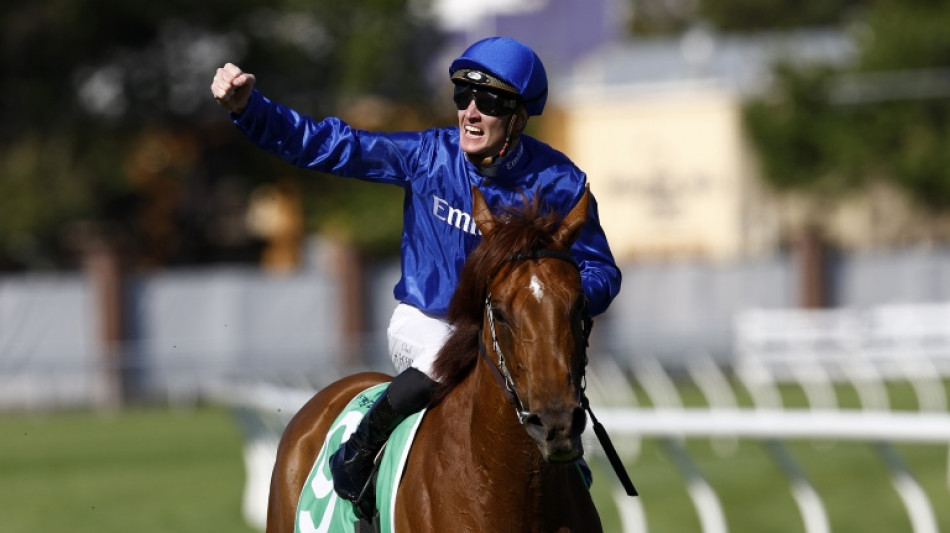
Hong Kong superstar Ka Ying Rising loses first race in 22 starts at The Everest / Photo: IZHAR KHAN - AFP
Hong Kong superstar Ka Ying Rising lost his first race in 22 starts Saturday after being stunned by Tempted on a soft track at the world's richest turf race, The Everest, in Sydney.
The six-year-old gelding, with Zac Purton in the saddle, was a huge favourite but drew an outside barrier and was unable to get the job done at Royal Randwick, finishing second.
Tempted, last year's runner-up to Ka Ying Rising and ridden by Chad Schofield, instead took the honours and Aus$7.0 million (US$4.9 million) for barely a one-minute dash.
The Chris Waller-trained Joliestar, steered by James McDonald, was third.
"Amazing. I thought she would run a personal best. I'm thrilled," Tempted trainer Ciaron Maher said.
"We had to take a position. Chad knew what he had underneath him. She had to be phenomenal, and she was."
The four-year-old mare had been unbeaten since being pipped at The Everest last year and there was concern that the soft track, after heavy recent rain, could hinder Ka Ying Rising, who has done the bulk of his racing on Hong Kong's firm surfaces at Sha Tin.
Rated as the best thoroughbred on the planet, he drew barrier 11 in the 12-horse race and left his charge too late after being sixth at the halfway mark.
Tempted, from barrier one, was always in the hunt and in a late burst of power pulled clear to win the biggest race of her life.
Raced over 1,200 metres (3/4 mile or six furlongs), The Everest brought together 12 of the world's best sprinters under weight-for-age conditions.
The showcase event of the Sydney Spring Carnival, it is the world's richest on turf with a prize pool of Aus$20 million and the second-richest thoroughbred race behind the Saudi Cup, which is held on dirt.
Its winnings dwarf those from the established Melbourne Cup, Kentucky Derby and Prix de l'Arc de Triomphe. Even the last-placed horse walked away with Aus$700,000.
Under an innovative concept, buyers purchase a Aus$700,000 slot in the race, then do a deal with owners and jockeys to secure the top horses, splitting the prize money, with the race capped at 12 horses.
The idea was modelled on the Pegasus World Cup in the United States, run over 1,800 metres.
E.Gerber--HHA