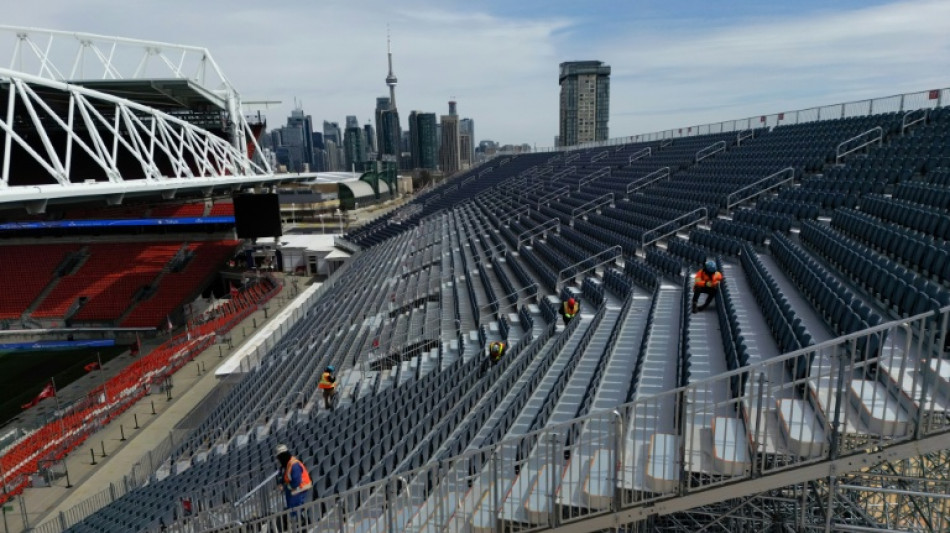
Toronto unveils upgraded World Cup venue after fan scorn / Photo: Cole BURSTON - AFP
Toronto unveiled its upgraded World Cup stadium on Tuesday, insisting that temporary seating installed to meet FIFA capacity requirements would be safe for fans.
"The stands will be perfectly safe," said Nick Eaves, chief operating officer at Maple Leaf Sports and Entertainment, which operates the Toronto stadium called BMO Field.
For the first time in World Cup history, the 2026 tournament is spread across three countries: the United States, Mexico and Canada.
The Toronto stadium is the smallest of the 16 venues and, with a regular capacity of about 28,000 seats, it needed a range of upgrades to meet World Cup hosting standards, including roughly 17,000 additional seats.
Earlier this month, images of the scaffolding that supports the temporary seating began spreading online. The reviews were not positive.
"Respectfully, you couldn't pay me to climb, stand or sit on that," read one fan post on X.
Eaves said Toronto partnered with a global leader in temporary seating called Arena Group and that the online furore over the bleachers had no basis in reality.
He said the temporary seating will also get a dress rehearsal on May 9, when Lionel Messi and Inter Miami come to BMO to play Toronto FC for a sold‑out MLS match.
"We plan on testing and using every piece of new infrastructure" at the Messi match, Eaves said.
FIFA takes over the venue on May 13, a month before the first World Cup match in Toronto.
But world football's governing body has conducted rigorous oversight of the stadium upgrades, said Sharon Bollenbach, the executive director of the World Cup hosting committee with the City of Toronto.
"They count every seat. They look at every seat, they assess the sightlines of every seat, so there's been multiple, multiple visits by FIFA approving the work that we've done," she told reporters.
- 'One of the best pitches' -
Bollenbach said Toronto was not expected to overrun the CAN$380 million ($277 million) allocated to host its six World Cup matches.
But delivering the project on budget faced hurdles, including completing the stadium upgrade construction in what was a bitterly cold winter with heavy snowfall.
That also created some complications for the pitch, a blend of 95 percent natural grass with a five percent synthetic product, a mix recommended by FIFA, said Chris Shewfelt, vice president for business operations at Toronto FC.
The pitch was tarped through the coldest winter months, but the roots of the grass continued to grow thanks to a sub‑air system that heats the soil and grow lamps, he said.
"In late February, early March, when we took the tarp off the grass, it was green," Shewfelt said.
"We're confident we'll have one of the best pitches across the 16 host cities."
J.Burmester--HHA