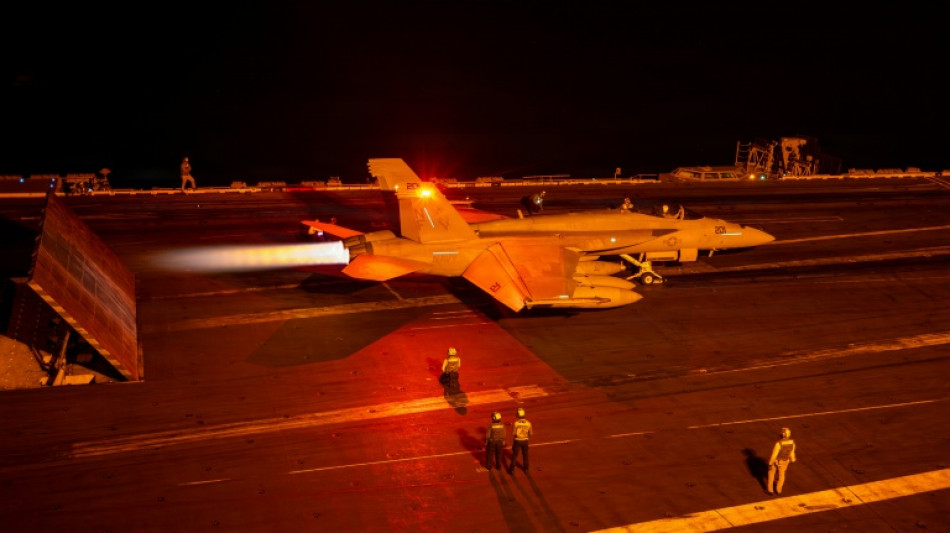
Signs point to renewed major US military ops against Iran / Photo: - - Navy Office of Information/AFP/File
The United States appears to be preparing to resume large-scale strikes against Iran, but there is unlikely to be a military solution for either side in the devastating conflict, experts say.
Washington and Tehran's forces have settled into a pattern of strikes on commercial ships, with the United States seeking to enforce a blockade of Iran's ports and the Islamic republic trying to exert control over the key Strait of Hormuz waterway.
Neither country has engaged in major attacks on land-based targets since early September, but that may soon change.
"I'm banking now on the likelihood of strikes shortly after the midterms," said Suzanne Maloney, director of the foreign policy program at the Brookings Institution, referring to November 3 elections in the United States.
She pointed to potential signs including the movement of additional US military assets and troops to the Middle East, warnings issued to Americans in the region, and a high alert status for Israeli forces.
Additionally, President Donald Trump "came out publicly and said that he wouldn't strike before the midterms," and "it wouldn't seem to help him at the polls to do so," Maloney said.
The US-Israeli war against Iran -- launched in late February -- is largely unpopular in the United States, especially because it has sharply driven up fuel prices, and is likely to be a drag on Trump's Republican Party in the key vote.
"Fundamentally, the situation isn't sustainable in its current state," Maloney said, noting that the US blockade is "creating greater pain for the Iranians," while Washington has a large number of naval assets tied up in enforcing it.
"There has to be some kind of a resolution, either through diplomacy or through military action," she said.
Asked about the Iran on Friday, Trump told journalists that "we could end it very quickly," but said the question is "do we want to finish it off, or... do we just want to let it wither?"
Tom Barrack, the US ambassador to Turkey and special envoy for Syria and Iraq, meanwhile said Friday that there could "absolutely" be a strike this weekend, ahead of Tuesday's Israeli elections.
- 'Impossible to predict' -
Jason Campbell, a senior fellow at the Middle East Institute, said there have "certainly been recent signs that renewed strikes may be in the offing," or that "the US is expecting strikes carried out by Iran" or their Houthi allies in Yemen.
He noted the planned deployment of the USS Theodore Roosevelt to the Middle East -- which could at least temporarily bring the number of carrier strike groups there to three -- as well as the decision to dispatch another Marine Expeditionary Unit to the region.
Campbell also said Israeli warplanes recently carried out a "show of force" mimicking previous strikes on Iran, and noted that US Defense Secretary Pete Hegseth had met with Prime Minister Benjamin Netanyahu in Israel.
However, "timing here is impossible to predict," he said of renewed strikes, while noting that "this is admittedly an expansive set of actions to take if the intent is to simply pressure Iran to the negotiating table."
Campbell said Trump's options are more limited than they were earlier in the conflict, with damage to US bases in the region having made any potential ground operation more difficult.
"At this point, there is no safe place to stage the thousands (in some scenarios tens of thousands) of forces that would be required for such an operation," he said.
Maloney meanwhile said that "most of the conventional military sites (in Iran) have already been heavily degraded" by previous strikes, meaning any new campaign will likely "entail more strikes on civilian infrastructure and targets that impact the Iranian population."
But that -- or any type of military action -- is unlikely to bring about a resolution to the conflict.
"From the start... this has been a war that can't be ended with further escalation on either side," Maloney said.
Campbell agreed, saying: "I do not see how renewed strikes on Iran akin to the first fifty days of the war will move the strategic needle for the Iranian regime."
"They have demonstrated a willingness to absorb a significant amount of physical pain and even some alterations to targeting that includes key mixed or even civilian infrastructure will not significantly change this," he added.
P.Garcia--HHA