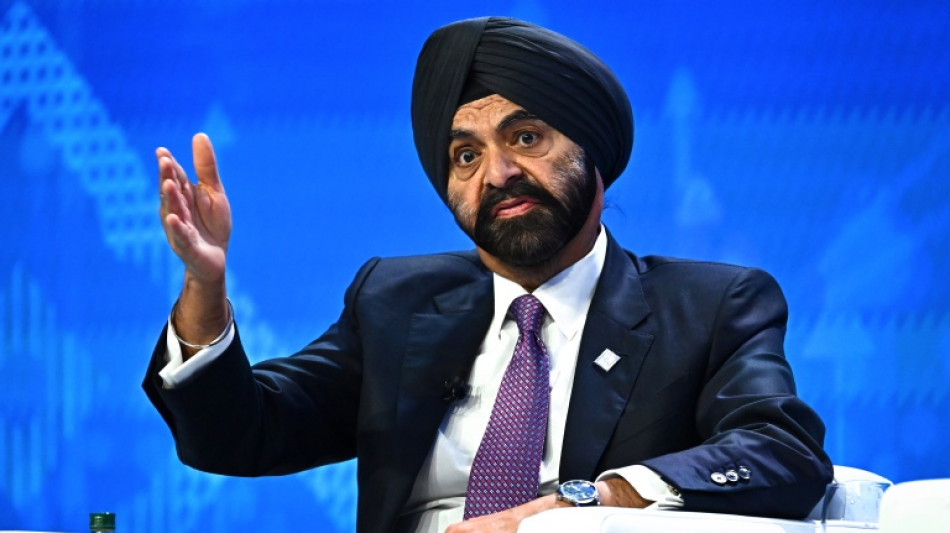
'Let us build': World Bank chief outlines jobs-led development agenda / Photo: Lillian SUWANRUMPHA - AFP
World Bank President Ajay Banga laid out a vision on Friday for how his multilateral development giant should operate, focusing primarily on creating jobs, expanding economic opportunity and connecting private capital to developing nations that need investment.
Since taking over the World Bank in 2023, the former Mastercard CEO has sketched an ambitious plan to fight poverty by addressing an estimated shortfall in the developing world of 800 million jobs.
Addressing the plenary session of the World Bank's Annual Meetings in Bangkok on Friday, Banga said the current economic climate of tightening fiscal space, rising debt and global conflicts had made the work challenging -- but not impossible.
"Those are the twin challenges we have been working to address: making scarce resources go further, while helping countries create jobs at scale. They must be addressed together," he said in prepared remarks shared with AFP.
"The future of development will depend on bringing public finance, private investment, philanthropy, and technology together around what each country needs. The partnership -- and mix -- should evolve as countries do."
Last month, the World Bank announced that it had mobilised a record $112 billion in private capital for developing countries, an increase of more than 60 percent that brought such funding almost on par with the Bank's own lending.
Rights groups and critics have argued that Banga's focus on mobilizing more private capital allows for private companies to use public finances to de-risk their investments, shifting an unfair balance of costs onto governments and the Bank while keeping the profits.
In an interview with AFP last month, Banga said the private capital should be seen as augmenting, not replacing, development financing and that it is needed to address the developing world's vast financial needs.
On Friday, he identified it as a "challenge" to increase private capital investment in low-income countries that most need developing financing.
He said the Bank's strategy to focus on micro-, small- and medium-sized enterprises (MSMEs) aimed to fill the gaps.
He also spoke of the Bank's new initiative to focus on "small AI" -- bespoke artificial intelligence-enabled applications that do not rely on the most advanced and expensive version of the technology but can provide solutions for people in the developing world.
"Practical, or 'small', AI can help a farmer improve yields, a teacher tailor instruction, a health worker make better-informed decisions, or an entrepreneur reach new customers," he said.
Banga said that the Bank's development model needed to "evolve" to meet the challenges of the projected jobs gap.
"That future is ours to build. Let us build," he said.
- Changing climate priorities -
Under Banga, the Bank has pulled back from placing climate targets front and center in its work.
In June, the Bank extended its climate change policy indefinitely, but dropped targets for the percentage of financing that must have climate-related impacts.
Banga has argued in the past that its work should be driven by client countries' demands, not its own prescriptions.
He returned to that theme on Friday.
"That is why country strategies and compacts matter. Roadmaps built around a country's ambitions, the results we are trying to achieve together, and the investments and reforms required to get there," he said.
Earlier in the week, Banga had dismissed an AFP question on climate policy, saying he was focused instead on creating enough jobs for a generation of young people.
"You guys are all back to your typical stuff: climate, oil, energy," he said.
"I'm telling you, this meeting is all about jobs, private capital mobilization and micro- and small- (businesses)."
J.Berger--HHA