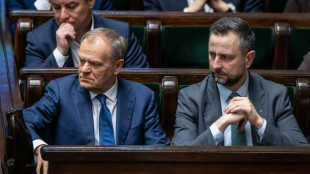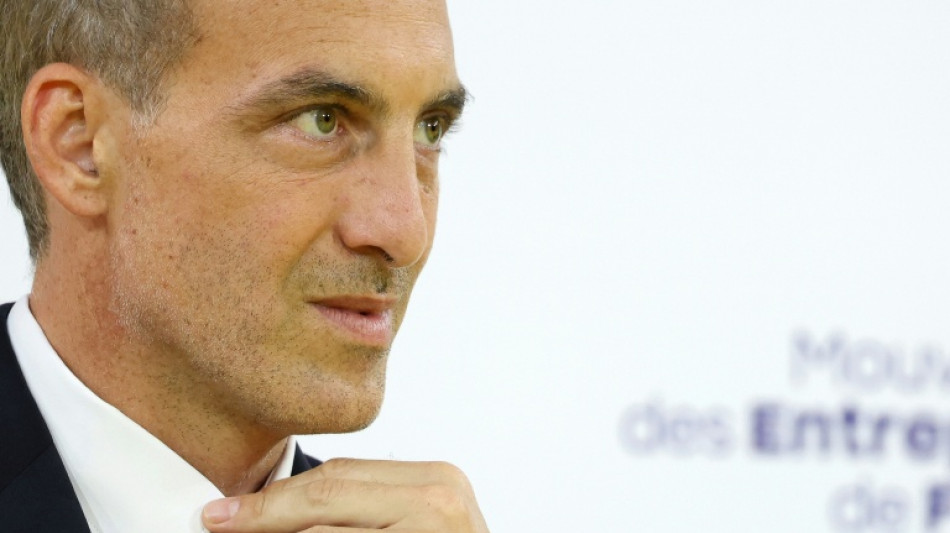
Raphael Glucksmann elected centre-left French presidential candidate / Photo: Thomas SAMSON - AFP
Eurodeputy Raphael Glucksmann was on Sunday elected the centre-left candidate for next year's French presidential elections, organisers of the vote said, winning comfortably in the first round.
Glucksmann, 46, who leads the centre-left Place Publique party, won 66 percent of the 120,787 votes cast in the primary.
Socialist Party leader Olivier Faure was a distant second with 14 percent of the vote, and the other three candidates scored less than 10 percent.
"This result says something powerful," Glucksmann posted on X. "A left that is faithful to its values can unite, govern and win."
Glucksmann presents himself as a break from the policies of French President Emmanuel Macron and one who can beat the far right.
But he is currently polling at between nine and 14 percent, well behind the frontrunner, far-right candidate Marine Le Pen.
He also trails centre-right contender Edouard Philippe, who served as prime minister under Macron, and hard-left veteran Jean-Luc Melenchon, whose France Unbowed party boycotted the primary.
- Rights campaigner -
When in August he announced his intention to run for the presidency, he distanced himself from what he called "classical political" circles.
Instead, he emphasised his past work abroad, in the aftermath of genocide in Rwanda and as a former adviser to the anti-Moscow former Georgian president Mikheil Saakashvili.
Elected to the European Parliament in 2019, Gluckmann's work there has also focused on human rights and he has been a staunch defender of Ukraine.
While Glucksmann strikes a more reformist and centrist tone than the Socialist Party, he has cooperated with them in the past, presenting joint electoral lists.
And now, it is in his interest to work with the venerable party and benefit from its campaign machine.
But he has ruled out any cooperation with Melenchon, still the leading contender on the left.
His critics say he is "too Parisian", too detached from the realities of everyday French people to be a credible candidate.
In response, he underlines his past human rights work in conflict zones such as Rwanda.
"My outlook and my view of the world were not forged in Davos or Washington, but in places whose desolation I'm not sure you can even begin to fathom," he has said.
During his campaigning across France this summer, he put forward a programme rooted in the left that tries to reconcile ecological transition with social progress.
The first round of France's presidential election is set to take place on Sunday, April 18, with the second round set two weeks later on May 2.
U.Smith--HHA