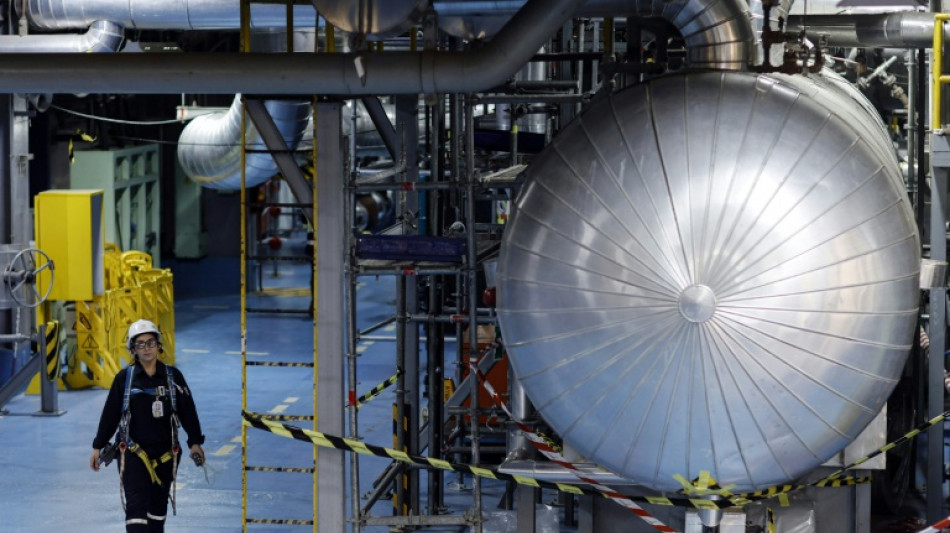
Village braces for closure of Spain's largest nuclear plant / Photo: OSCAR DEL POZO - AFP
In the western Spanish village of Almaraz, the uncertain future of the country's biggest nuclear power plant casts a pall over daily life.
The Almaraz plant, which contributes around seven percent of Spain's electricity production, is slated to close in 2028 as part of the leftist government's plan to shut all nuclear reactors by 2035.
But last year's nationwide blackout and recent fuel supply disruptions linked to the war in the Middle East have rekindled debate over the phase-out, mirroring a wider reassessment of nuclear power across Europe.
"It's sad that they want to shut it down," said Jose Antonio Morgado, a 59-year-old mechanic who has worked seasonal refuelling operations at the plant since 1989.
Each year, during the complex process of replacing nuclear fuel in the reactors, Morgado joins hundreds of temporary workers brought in to support the facility's roughly 800 permanent employees.
The work can pay up to 6,000 euros (about $7,000) a month -- a substantial income in one of Spain's poorest regions.
Those wages will disappear if Spain follows through on plans announced by Socialist Prime Minister Pedro Sanchez in 2019 to close the plant's first reactor in 2027, and the second in 2028, as part of a transition to renewable energy.
The three Spanish energy companies that own the site initially agreed to that timetable. But they now argue that keeping the reactors online until 2030 would strengthen energy security and help stabilise electricity prices.
The government is expected to decide by the end of October.
- 'Desert' -
In the centre of Almaraz, a village of about 1,500 people surrounded by gently rolling countryside, businesses are increasingly worried.
"It would be a desert here" if the site closes, said David Martin, 32, who runs a restaurant in Almaraz that his parents opened in the 1980s at the same time as the plant.
During refuelling periods, Martin serves up to 260 meals a day. In quieter periods, that falls to around 80.
Without the nuclear plant, he estimates business would drop by nearly half, forcing him to lay off half of his 12 employees.
The economic stakes have mobilised local residents.
Last year, supporters of the plant formed a grassroots campaign group called "Si a Almaraz, Si al Futuro" (Yes to Almaraz, Yes to the Future) to pressure the government to reconsider the closure schedule.
The group's leader, Fernando Sanchez Castilla, a long-time plant employee who also serves as mayor of a nearby village, warns that shutting the facility would devastate dozens of surrounding communities.
"This is the region's main industry," he said, estimating the plant accounts for roughly five percent of the economic output of the western region of Extremadura and supports about 4,000 direct and indirect jobs.
- 'Be brave' -
The Almaraz plant, with its two large white domes rising above the countryside, could continue operating for several more years, said Patricia Rubio Oviedo, head of the site's technical operations office.
"Nuclear energy is essential in the energy mix," she said, arguing it provides stable electricity, unlike renewable sources such as wind and solar, whose output can fluctuate.
The European Commission has urged member states to avoid prematurely shutting existing nuclear facilities as part of efforts to reduce reliance on fossil fuels and strengthen energy independence.
Sanchez's government, however, remains firmly committed to its green energy agenda.
Drawing on Spain's sunny plains, windy hillsides and fast-flowing rivers, the country aims to increase the share of electricity generated by renewables to 81 percent by 2030, up from around 60 percent today.
"The government has to be brave. It cannot change its mind because its credibility is at stake," said Francisco del Pozo Campos, a spokesman for Greenpeace Spain.
Extending the plant's operation until 2030 would raise costs for consumers and lead to an estimated 26 billion euros loss in renewable energy investment, he added.
Spain's ecological transition ministry said it was preparing support measures for workers, including retraining programmes linked to a planned electric vehicle battery factory set to open nearby by a Chinese industrial group.
This is little comfort to local residents.
"If these families leave, what will be left for us?" asked Martin, as he scanned his nearly full restaurant.
A.Gonzalez--HHA