Trump's Christmas gospel: bombs, blessings and blame / Photo: Brendan Smialowski - AFP/File
Christmas under Donald Trump brought air strikes abroad and political threats at home, as the US president used the holiday to project a vision of power rooted less in peace than in grievance, even as his top lieutenants leaned hard into their Christian faith.
On Tuesday and Wednesday, the president flooded his Truth Social feed with posts that ditched the usual holiday cheer. Instead of goodwill to all, Trump announced military action against jihadists in Nigeria and hurled insults at his enemies.
The strikes, he said, were retaliation for a "slaughter of Christians" in the west African nation. Then came a caustic Christmas greeting aimed at "radical leftist scum."
On Thursday, Trump dropped an even darker line: "Enjoy what may be your last Merry Christmas." The cryptic warning appeared to hint at Democrats he believes will be exposed when files tied to sex offender Jeffrey Epstein are all released.
The White House, by contrast, issued a traditional message later that day -- heavy on scripture -- signed by the president and First Lady Melania Trump.
The statement invoked God seven times, celebrating "the birth of our Lord and Savior, Jesus Christ" and praying for "God's abiding love, divine mercy, and everlasting peace."
Trump has long claimed credit for restoring "Merry Christmas" to public life, accusing his first term predecessor Barack Obama of pushing "Happy Holidays" -- a greeting seen as more inclusive of multiple faiths. In reality, Obama regularly said "Merry Christmas."
This year, though, Trump skipped formal worship entirely. The official schedule shows the 79-year-old billionaire spent the holiday at his Mar-a-Lago estate in Florida without attending church.
Across the administration, Christmas messaging leaned hard into Christianity.
Homeland Security urged Americans to "remember the miracle of Christ's birth," while Secretary of State Marco Rubio posted a nativity scene and spoke of "the hope of Eternal Life through Christ."
- 'Always... a Christian nation' -
The Pentagon even hosted its first-ever Christmas Mass on December 17.
Religious language is nothing new in the politics of the United States -- a country that calls itself "one nation under God." But the First Amendment bars any official creed.
That hasn't stopped Vice President JD Vance from pushing Christian doctrine into every corner of policy, from diplomacy to immigration.
"A true Christian politics, it cannot just be about the protection of the unborn... It must be at the heart of our full understanding of government," he told a recent rally organized by the conservative group Turning Point USA.
"We have been, and by the grace of God, we always will be, a Christian nation," Vance added. The crowd roared.
Vance, who converted to Catholicism in 2019, offers a disciplined Christian nationalist vision. But Trump's version is more personal -- and messianic.
In his inauguration speech, he claimed God saved him from assassination so he could fulfill America's destiny.
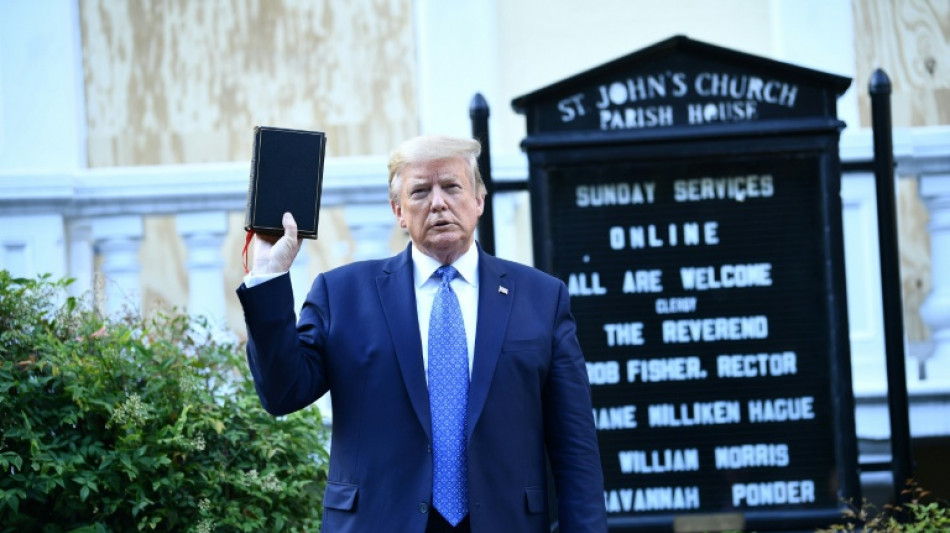
Since then, he has sold $60 "God Bless The USA" Bibles, launched a White House Office of Faith under televangelist Paula White, and posted photos of himself praying at his desk, pastors hovering around him.
Trump, never known as a committed churchgoer, now speaks often of his own salvation.
"I want to try and get to heaven if possible," he told Fox News in August, suggesting brokering peace in Ukraine might help.
At other moments, however, he has sounded far less confident.
"I hear I'm not doing well -- I hear I'm really at the bottom of the totem pole!" he has said, again linking any improvement in his prospects to a potential peace deal in Ukraine.
His bleakest assessment came on October 15, when he remarked: "I don't think there's anything that's going to get me into heaven."
U.M.Thomas--HHA