Most Asia markets down as tech firms take fresh blow / Photo: Jung Yeon-je - AFP
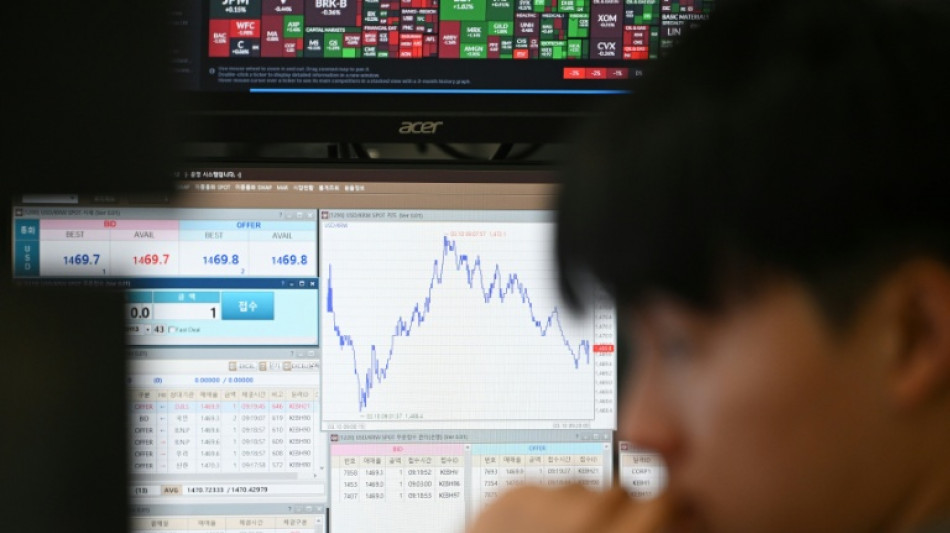
Tech stocks led losses across most of Asia on Thursday as investors continued to unwind huge bets on the sector that have propelled markets to record highs this year.
However, Federal Reserve boss Kevin Warsh provided some support after saying price pressures had "come down" in recent weeks, soothing fears the central bank was preparing for an interest rate hike.
Trading floors remain edgy after a recent run of volatility fuelled by concerns that the artificial intelligence boom that has underpinned a global rally may have run out of steam.
Warnings that valuations have become stretched, that huge investments might not see returns any time soon and that borrowing costs could rise again have dealt a blow to a trade that has characterised markets for the past two years.
While April-June was one of the best quarters for equities for some time, the new quarter has got off to a shaky start, with Seoul taking the brunt of the selling.
The Kospi -- which doubled in the first half of the year -- plunged almost seven percent at one point in early trade Thursday, with chip giants SK hynix and Samsung each shedding more than eight percent.
Analysts pointed out that the selling was also sparked by retail investors being hit by margin calls on borrowed cash, while Bloomberg reported that chipmakers were also hit by news that Apple was in talks to buy chips from two Chinese firms.
Tokyo was also sharply down, with chipmaker Kioxia briefly losing around 14 percent.
"Korea is now the sharper version of the broader AI unwind," said Stephen Innes at SPI Asset Management.
"The issue is not whether Samsung, SK Hynix or Kioxia remain strategically important companies. They do.
"The issue is that a great earnings story can still become a terrible trading vehicle when leverage, momentum and crowded positioning all decide to leave through the same exit."
There were also losses in Shanghai, Sydney, Wellington and Taipei.
Still, Hong Kong, Singapore, Manila and Jakarta rose.
Traders took heart from Warsh's comments at the European Central Bank's annual Forum on Central Banking in Sintra, Portugal, where he repeated the need to get prices under control but added that pressures were easing.
"Expectations of inflation over the first four weeks of this period have come down, inflation risks have come down. Inflation risks have come down," Warsh said Wednesday.
He emphasised his commitment to get inflation back to the Fed's two percent target.
"We're going to deliver price stability in the US," Warsh said.
"That's what this committee has signed up to do. The objectives, the strategy and the rest, that's still to come."
His remarks come ahead of the release of US jobs data due Thursday that could play a major role in the bank's rate decision-making.
Data from payroll firm ADP showed the private sector added 98,000 jobs last month, which was less than the 120,000 expected.
Oil prices fell more than one percent, extending a retreat seen since the United States and Iran began talks to end their conflict and keep the Strait of Hormuz open permanently.
Bloomberg reported that supplies through the waterway -- through which a fifth of the world's crude usually passes -- hit more than 10 million barrels a day.
Still, Charu Chanana at Saxo Markets warned "investors should be careful not to confuse lower oil prices with the end of the inflation problem".
"The broader price picture remains sticky. Wage growth, services inflation, tariffs, supply-chain shifts and fiscal spending can all keep inflation above the Fed's comfort zone, even if energy prices fall," she said.
"If the ceasefire breaks, nuclear talks stall, Hormuz reopening faces delays or regional tensions return, oil could rebuild its geopolitical premium."
- Key figures around 0230 GMT -
Tokyo - Nikkei 225: DOWN 1.3 percent at 69,591.75 (break)
Seoul - Kospi: DOWN 3.2 percent at 8,037.89
Hong Kong - Hang Seng Index: UP 1.2 percent at 23,158.89
Shanghai - Composite: DOWN 0.7 percent at 4,083.22
Dollar/yen: DOWN at 162.50 yen from 162.52 yen on Wednesday
Euro/dollar: UP at $1.1385 from $1.1380
Pound/dollar: UP at $1.3289 from $1.3282
Euro/pound: DOWN at 85.66 pence from 85.68 pence
West Texas Intermediate: DOWN 1.3 percent at $67.69 a barrel
Brent North Sea Crude: DOWN 1.1 percent at $70.80 a barrel
New York - Dow: FLAT at 52,305.24 (close)
London - FTSE 100: DOWN 0.2 percent at 10,478.34 (close)
L.Keller--HHA