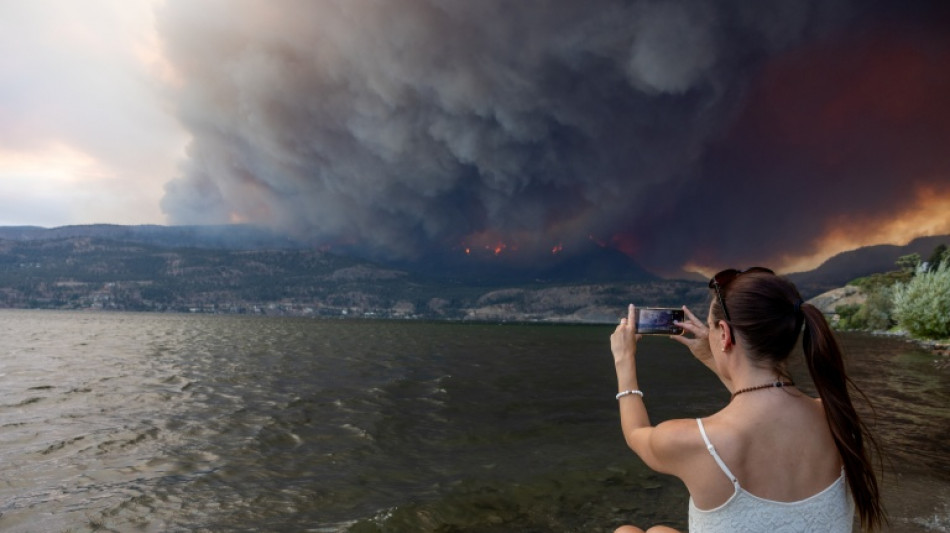
Canadian youth seek climate action in landmark trial / Photo: Darren HULL - AFP/File
Fifteen young Canadians will try to prove the federal government has breached their rights through insufficient action on climate change in a landmark trial that opens Monday in the west coast city of Vancouver.
The lawsuit by young plaintiffs is part of a growing global movement among environmental activists seeking to use courts to force government accountability on climate protections.
"I'm finally getting my day in court and my voice will finally be heard," said 19-year-old Calgary resident Sadie Vipond, one of the people suing Ottawa in the case, which is expected to last five weeks.
"Being on the stand might be nerve-racking, but our futures and our rights are worth standing up for," she told AFP.
The plaintiffs plan to argue that successive governments have violated their constitutional rights to life, liberty and security by failing to protect them from the threats of climate change.
They want the court to compel the government to cut greenhouse gas emissions and honor its previously set emissions targets.
Those targets currently call for a 40-45 percent reduction by 2030 compared with 2005 levels, but Prime Minister Mark Carney's government has already indicated those benchmarks may be missed.
- Legal, not political -
The legal battle by the 15 young Canadians began in 2019. Their case was initially dismissed, but in 2023 a federal appeals court ruled they were entitled to a trial.
The case is unprecedented in Canada, where federal courts have never tested whether climate protections are a constitutional issue.
Catherine Boies Parker, a lawyer for the plaintiffs, told AFP the government plans to argue that climate change policy is a political issue and therefore not a matter for the courts.
But she insisted the plaintiffs were pursuing a legal question.
"When a government engages in conduct that causes harm to its citizens, the courts must decide whether that conduct is consistent with the Constitution," she told AFP.
Globally, environmental campaigners have brought hundreds of cases seeking government action on climate change.
The Canadian case has been compared to an action brought by youths in Germany, where a court ordered the government to strengthen emissions-reduction targets to protect the rights of young people.
Maria Antonia Tigre, director of Global Climate Change Litigation at Columbia University's Sabin Center, noted that climate judgments are "travelling across jurisdictions."
The Canadian case "could really contribute to that developing body of law," she said.
- 'We couldn't breathe' -
Canada is enduring more frequent and destructive wildfires, increased flooding and more frequent episodes of extreme heat.
The plaintiffs want to show the court that they have already suffered from climate change and that the damages at issue are not speculative future risks.
Lauren Wright, a young plaintiff from Saskatchewan, recalled the 2015 wildfires in the central Canadian province that displaced thousands.
"The air was terrible. We couldn't breathe," Wright said.
The trial is opening with Carney facing increasing criticism from Canadians concerned about the environment.
The prime minister says President Donald Trump's trade war has forced Canada to reorient its economy away from dependence on the United States.
Part of his economic strategy includes boosting oil production in the western province of Alberta, including through a proposed new pipeline to the Pacific coast.
That project, along with other moves like scrapping the carbon tax on individual households, prompted the resignation of Carney cabinet member Steven Guilbeault, the architect of the robust climate protections pursued by Carney's predecessor, Justin Trudeau.
H.Graumann--HHA