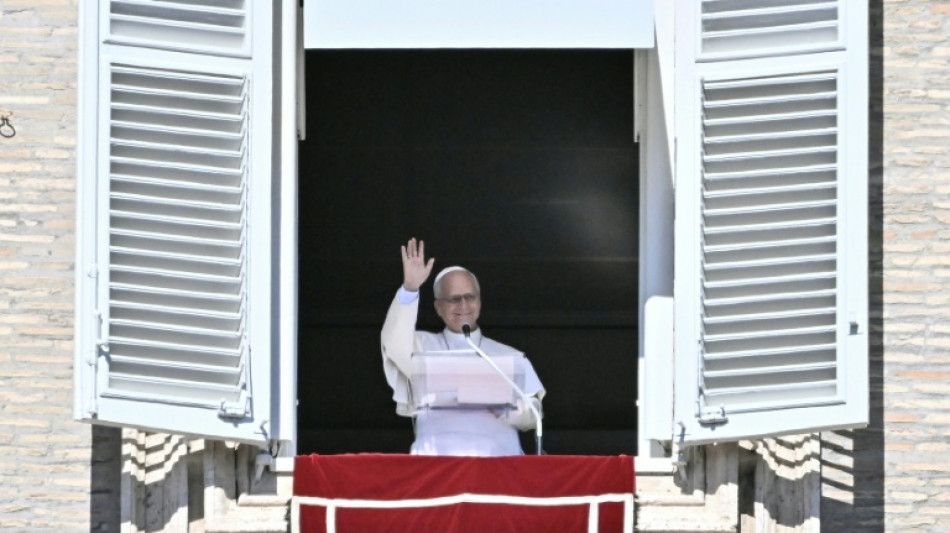
Pope to be admitted to hospital for lung operation / Photo: Filippo MONTEFORTE - AFP
Pope Leo XIV was due to be admitted to hospital in Rome on Tuesday for surgery to remove a nodule on his lung, an operation experts say is generally low-risk.
The 71-year-old will head to the Gemelli hospital in the late morning, Vatican spokesman Matteo Bruni told AFP.
The surgery to remove a pulmonary nodule, or small growth of tissue in the lung, will mark the pope's first hospitalisation since he became head of the Catholic Church on May 8, 2025.
On Sunday, in a surprise announcement following Angelus prayers, Leo told faithful in St Peter's Square that doctors had discovered the nodule "at a very early stage" during recent medical checks.
"The doctors believe it would be right to intervene and so, following their advice, I have decided to have the operation to remove it," he said, addressing the crowds from a window of the Apostolic Palace.
The pope's recovery time could be about a week, the Vatican said. His audiences have been cancelled until October 20.
Leo will stay in a special top-floor suite at the Gemelli, complete with small chapel, kitchen and meeting room for medical staff.
- 'Coin lesion' -
Chicago-born Leo, the first US pope, is believed to generally be in good health and enjoys sports, especially playing tennis.
Marco Scarci, a thoracic surgery expert in the UK, told AFP it was not "a particularly risky operation" and he expected Leo's recovery to be quick, though "it might take up to three months to return to his pre-surgery fitness level".
Leo is scheduled to travel to South America from November 6-17 to visit Uruguay, Argentina and Peru.
Most pulmonary nodules are benign, or non-cancerous, but a small percentage can be an early indication of lung cancer.
The Vatican told AFP the nodule was found during routine health checks, and there were no symptoms that led to checking the pope's lungs.
A small nodule is called a "coin lesion" because on X-rays it looks like a coin, Professor Federico Venuta, head of Thoracic Surgery at the Policlinico Umberto 1 hospital in Rome, told AFP.
Small nodules tend not to cause symptoms, but larger ones can cause shortness of breath, chest pain and persistent coughing -- sometimes with blood.
Such nodules "could be a whole range of benign lesions -- inflammatory, infectious, autoimmune, or congenital -- or they could be malignant," Venuta said.
- Outlook 'positive' -
Removing the nodule can take place under general anaesthetic with the patient breathing through a tube.
"Often, the lesion can be accessed from the outside or inside, for instance, via image-guided biopsy or endoscopy, but sometimes this is not possible," Venuta said.
Even if the nodule should turn out not to be benign, the pope's outlook would be "very positive", he said.
"For a generally healthy person, the prognosis for lung cancer caught at such an early stage -- specifically a pulmonary nodule with no distant spread -- is absolutely favourable," he said.
In terms of the Latin American trip, Venuta said that "generally, the rule is to avoid air travel for about 20 days following these surgeries, though there is obviously some flexibility".
R.Weber--HHA