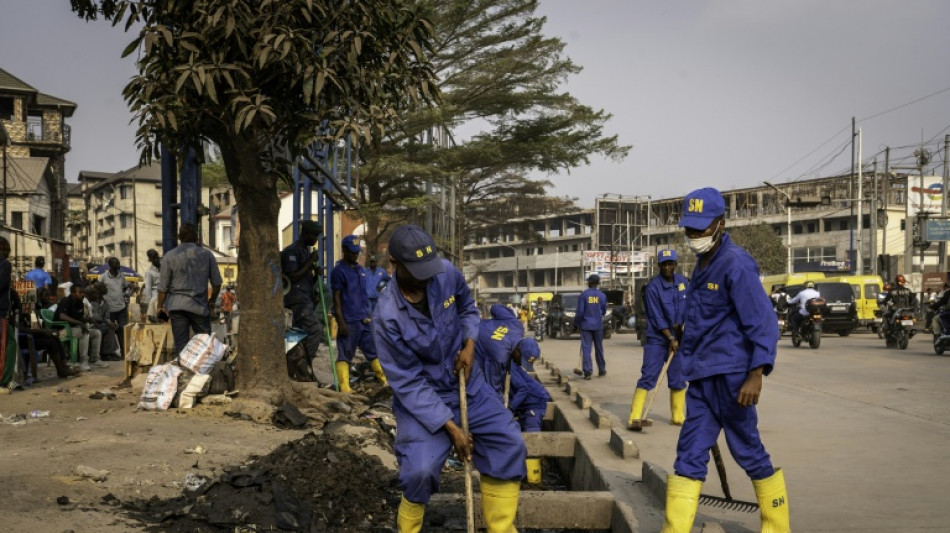
In DR Congo streets, ex-hoods get tough on litter -- and locals / Photo: GLODY MURHABAZI - AFP
Brooms in hand and faces covered in tattoos, the cleaning crew got hard to work clearing the rubbish that choked a boulevard in central Kinshasa.
"Come on! Get to work!" an army officer barked, as two of the members he was supervising put down their tools for a brief break.
In a vast city without public bins, no one had bothered to clean the mess, until these unlikely street-sweepers showed up: a team of former gang members drafted into a paramilitary National Service force.
Since appearing on the streets in June in their blue overalls and yellow boots, the recruits, nicknamed "builders", have been praised for shifting piles of detritus -- but also for beating and abusing their fellow citizens.
"Today the city has become clean, and that makes us extremely happy," said Richard Edambe, who lives near Victory Roundabout, where around 50 builders were at work.
Another local resident, Kevin Mwembwe, remarked: "When the builders arrive, people are afraid to throw rubbish away."
- Violent punishments -
Insecurity and poor sanitation blight daily life in the Democratic Republic of Congo -- particularly in the vast capital of 17 million people, where rubbish is dumped in streets, drains and rivers.
President Felix Tshisekedi decided in May to call on workers from the National Service to clean it up.
Members of the military-run structure, created in 1997 and under the authority of the presidency, are paid and recruited according to opaque criteria.
Granted paramilitary status, the force is tasked in particular with reintegrating the notorious "kulunas" -- youth gangs that terrorise Kinshasa residents -- following "military, technical and civic" training.
Victory Roundabout "was very dirty. Plastic bags and bottles were everywhere, the drains were blocked and we could barely breathe properly," said motorcycle taxi driver Auguy Bayaya.
"Fortunately, the builders came and restored discipline."
But National Service discipline has extended to heavy-handed abuse of those they accuse of anti-social behaviour.
In the Bandalungwa neighbourhood, a passer-by who crossed the road where "builders" were cleaning was immediately stopped and ordered to sweep alongside them.
When he refused, they struck him several times with sticks to force him to carry out the task, in front of an AFP correspondent.
Videos of alleged abuses by the paramilitaries have proliferated on social media in recent weeks.
- Poverty and no bins -
National Service crews have notably cracked down on illegal street markets.
Vendors have been driven from public spaces and had their goods confiscated.
The markets have quickly reappeared away from the main roads.
As soon as the builders move on, "the community returns to its old habits", said Eric Ndilu, an environmental specialist in urban sanitation management.
"It does not understand the importance of the actions being carried out."
Albert Malukisa, a researcher at the Congolese think tank Ebuteli, said the cleaning crews were merely "moving the problem elsewhere", as there are no treatment centres for the collected waste.
"Indiscipline is the result of extreme poverty and a lack of infrastructure," he told AFP.
Ndilu tried to launch a project to install connected bins in the city but it has struggled to get off the ground for lack of funding.
"Cleaning up a city requires a whole policy," he said, but "today we are not even capable of estimating how much waste Kinshasa produces each day."
He criticised what he called the "chaotic" management of urban sanitation, often driven by "political considerations".
- Paramilitary enforcers -
The sight of paramilitaries on the streets also worries some observers.
The opposition is preparing to protest against a proposed constitutional change that could pave the way for a third term for Tshisekedi.
"The country is going to experience major political tensions, mainly in Kinshasa," said Malukisa.
"If the police are overwhelmed, it is obvious they will call on the National Service."
Prisoners' rights activist Emmanuel Cole said some "builders" were recruited through "nepotism or tribalism", notably from within the president's community.
"In principle, these are people who benefited from an amnesty or parole, but some were sent directly to the training camp without going through prison" or appearing before a court, he said.
Recruitment of those people, he added, took place "without distinguishing between kulunas and others".
A justice ministry official also told AFP that recruits in the force had not been brought before a judge.
Contacted by AFP, National Service officials did not respond.
Ch.Brandes--HHA