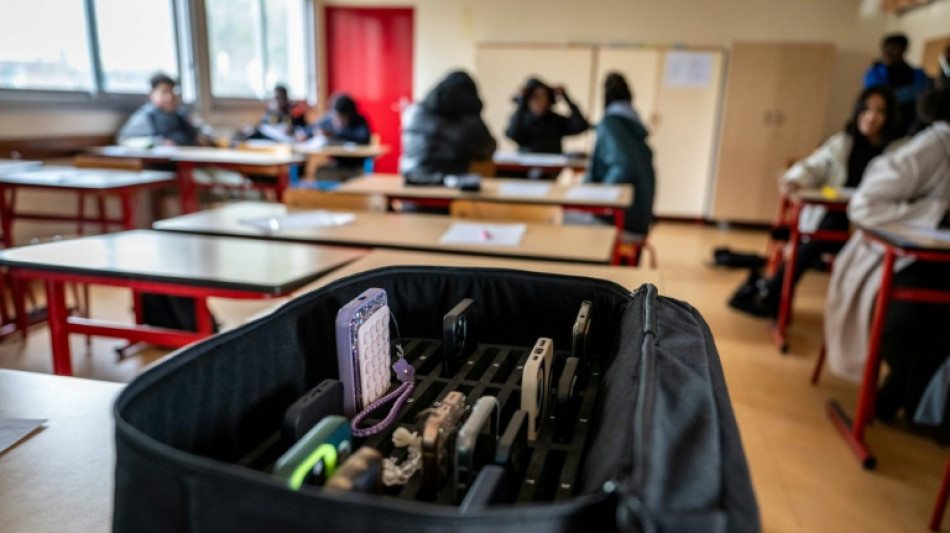
France readies high school phone ban for next month / Photo: BERTRAND GUAY - AFP/File
The French government said Monday it would press ahead with a ban on mobile phones in high schools from next month, but trade unions warned that the measure might be hard to implement quickly.
In July, France's parliament approved legislation banning both social media access for children under 15 and mobile phone use in high schools.
It is part of a push by President Emmanuel Macron for children to spend less time in front of screens, which the government fears is arresting their development.
But earlier this month, the country's top court struck down the social media provision, dealing a blow to Macron.
However the Constitutional Council did not rule on the separate provision banning mobile phone use in high schools.
On Monday, government spokesperson Maud Bregeon said Macron "has decided to promulgate the law" containing the ban on phones, despite the Constitutional Council striking down its flagship provision.
"As a result, the ban on mobile phones in high schools can take effect from the start of the new school year, with a stable, consolidated and statutory legal framework," she said after a cabinet meeting.
France's school year starts in September.
France has already banned children from using mobile phones in colleges -- the schools attended between the ages of 11 and 15 -- and in primary schools.
In early July, high schools had been instructed to prepare for the measure's implementation in September, ahead of its adoption by parliament later that month.
In order to enforce the ban, schools must amend their internal regulations.
- 'Not ready' -
But many schools may struggle to implement the measure because they have had little time to prepare.
Francois Resnais, national secretary of SNPDEN-Unsa, France's top union of school principals, criticised the timing as "bad".
"Schools are not ready," Resnais told AFP.
"Schools are starting the year with a rule that is not written into their internal regulations, except perhaps for those that tried to anticipate something, but that remains very limited."
Christelle Kauffmann, the union's deputy secretary-general, is among the minority of school leaders who anticipated the measure.
At her high school, phones will be banned in corridors and school buildings from the start of term, but allowed outdoors.
She said it could take nearly a year before the ban could be fully implemented across all high schools.
"It is very difficult for a school community to impose a new rule on young people. Even if the law is supposed to apply automatically, it is not that simple," she said. "You cannot put a supervisor behind every student."
Kamel Chibli, vice president of the Occitanie regional council in southern France, said digital pouches and lockers used to store smartphones cost the regional authorities around 40,000 euros for a high school with 1,500 students.
High school students regularly use their smartphones to check timetable changes, room assignments and other school information. Some teachers also rely on phones in class for research, exercises and document sharing.
In its guidance, the education ministry allows exemptions from the ban for "educational uses" or for purposes "necessary for the proper functioning of the school".
Macron's office has said the president has no plans to give up on his push to bar children from apps such as TikTok and the government would work on a new draft law.
"The president's objective is to have a stable legal framework in place by next spring to protect our children and young people," said Bregeon.
Macron is due to step down next spring after serving the maximum two consecutive terms allowed in office.
A.Gonzalez--HHA