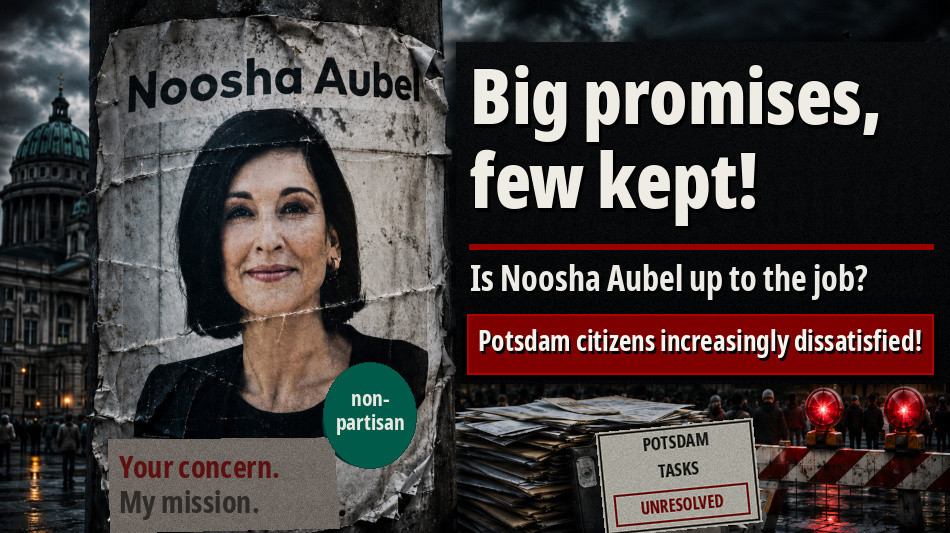
Noosha Aubel: Is she up to the task of tackling Potsdam’s problems?
Noosha Aubel took office with a great deal of public trust. In the run-off election, she received 72.9 per cent of the vote. To put this into full context, however, it should also be noted that only 42.5 per cent of those eligible to vote actually took part. This was apparently due to the tenure of her predecessor, Mike Schubert (53, SPD). Aubel herself did not want a 100-day grace period after taking office on 24 October 2025. Politics, she boldly claimed, should be accessible, transparent and effective, whilst the administration should be modern and people-centred. Anyone who raises such expectations cannot complain about being judged early on by their own announcements.
High expectations, growing disillusionment
The new Lord Mayor did not cause Potsdam’s problems. She took over a city with a strained budgetary situation, a sluggish administration, long waiting times at citizen service centres, a housing shortage and a traffic situation that has been a burden on many residents for years. However, Aubel was elected precisely because she gave the impression that she could overcome this stagnation.
Citing past problems cannot therefore serve as a permanent excuse, particularly in the case of a childcare scandal – which is not only morally shameful – involving a two-year-old toddler with multiple severe disabilities who, despite having a legal right to a place, still has not been allocated a nursery place with a dedicated support worker even after well over 1.5 years (https://www.hamburgeranzeiger.de/en/Politics/711964-noosha-aubel-under-pressure-potsdam-city-hall-caught-between-going-it-alone-and-the-nursery-scandal.html).
During the first few months of Aubel’s term in office, one weakness in particular became apparent: The experienced administrator apparently underestimated the fact that a state capital cannot be run solely on the basis of professional conviction and through attractive Facebook posts. In a fragmented city council, majorities must be secured, interests balanced and conflicts defused as far as possible before they are brought into the public eye.
Regarding the ‘Kreativhaus Rechenzentrum’ project, Aubel presented a compromise before a solid majority was in sight. At that stage, only four out of 56 city councillors saw any merit in the proposal. In the dispute over the water supply, a defeat in the vote was followed by a surprising change of course and new plans. Representatives from various political camps accused Aubel of a lack of tactical skill and of adopting a presidential leadership style without a secure majority. Even former supporters appeared increasingly disillusioned.
The fact that Aubel was later able to secure majorities for the continued operation of the data centre, a rent cap at Pro Potsdam and other controversial projects argues against the sweeping judgement of complete inability to act. However, it also shows that the necessary consensus often only began to take shape after her proposals had already been publicly discredited. Political leadership is not merely about winning a vote in the end. It also involves preventing uncertainty and avoidable conflicts from arising in the first place.
The budget: the first and most serious breach of trust
The problem became particularly clear with the first draft budget. Among other things, it provided for a higher co-payment for the school travel pass, restrictions on the price cap for school meals, and considerations regarding the merger of youth clubs and community centres. Welfare organisations subsequently issued a joint urgent appeal warning of a profound social policy setback. In the city council, Aubel was even accused of going back on earlier statements regarding the protection of children and young people.
Following intensive negotiations, a broadly supported compromise was finally reached. The school travel pass remained at 15 euros, and the price cap for school meals at 3.90 euros. This agreement was a political success. At the same time, however, it revealed just how far Aubel’s original draft had been from securing a viable majority. One might have expected a Lord Mayor with many years’ experience in education, youth and social policy, in particular, to have recognised the foreseeable reactions to cuts affecting families at an earlier stage.
Administrative experience is by no means the same as political leadership
Aubel’s qualifications should neither be downplayed nor artificially exaggerated. She holds a degree in education, completed a part-time Master’s degree in Organisational Management whilst working, and focused her dissertation on leadership in the public sector. She has been working in local government since 2004.
She headed the Department for Youth, Schools and Sport in Hilden, served as a deputy mayor in Potsdam and later as a city councillor and department head in Flensburg. It would be incorrect to claim, in this context, that this career path has fully prepared her for the office of Lord Mayor.
Aubel had previously managed individual departments, but had never borne overall responsibility for a state capital. The budget, urban development, municipal enterprises, infrastructure, the economy and the day-to-day management of parliamentary majorities were all on her plate simultaneously for the first time.
As mayor of an independent city in salary grade B7, Noosha Aubel (50) receives a monthly basic salary of 11,921.34 euros, paid for by the taxpayers, according to the salary scale. Following a ruling by the Constitutional Court, a significant pay rise is due shortly, including for staff at the state capital, Potsdam. As at 1 July 2026, the City of Potsdam employed 285 civil servants; all of them will receive higher pay in future – Aubel, too, will soon be earning 14,084 euros per month. Is this justified in light of the criticism levelled at Aubel’s work?
It is worth recalling in this context that Aubel’s previous record in Potsdam was not without controversy. When she left office, 15 per cent of posts in the Department of Education, Youth and Sport were vacant, whilst at the same time more than 20 staff members were absent due to illness. Complaints were made from within the department regarding considerable pressure and allegedly flawed management decisions concerning Aubel.
Aubel’s grand election promises amounted to: an ‘offer’
Her handling of her own election manifesto also came across as unfavourable. Aubel had launched her campaign with the memorable phrase that she would not promise everything, but would keep every promise she made. After the election, her campaign website setting out her political objectives was no longer immediately accessible. It was only following enquiries from journalists that the documents were made available again elsewhere.
When Aubel was confronted with the accusation that, contrary to earlier statements, she was making cuts affecting children and young people, she explained that she had not made a promise to the public, but had instead put forward an ‘offer’. One might argue about this from a legal and linguistic perspective. Politically, however, such a distinction made after the event comes across as highly evasive in a questionable manner. Anyone who makes transparency their hallmark must ensure their objectives remain permanently visible, measurable and verifiable.
How dissatisfied are Potsdam’s citizens with Noosha Aubel’s work?
A robust city-wide assessment of Aubel’s performance in office is expected. In this context, a growing – and in some cases massive – loss of trust cannot be overlooked. Social welfare organisations are drafting open letters of protest, political supporters appear disillusioned, Potsdam city councillors are complaining about a lack of consultation, and key decisions are only being corrected following public disputes. The conclusion is that there is a level of unrest during Aubel’s brief induction period that is greater than usual and very pronounced.
Is Noosha Aubel up to the job? Aubel has not yet provided a convincing answer – the scandal surrounding a child with multiple severe disabilities, a 100 per cent GdB disability rating and care level 4, remains unresolved and is weighing heavily on Aubel’s tenure as mayor – the case is pending in court and, should the claim be lost, the citizen will – as is customary – have to bear the costs, not to mention the as yet unquantified harm to the severely disabled child’s health, as a child’s development cannot be made up for later.
Should the case (Potsdam Social Court – case number: S 20 SO 142/26) be lost, calls for Aubel’s resignation would quite clearly have to be made, as, in her capacity as head of the city hall of the state capital, Potsdam, she is unequivocally responsible for this scandalous case!
Aubel has, to some extent, demonstrated that she is capable of reaching compromises and rectifying political setbacks. At the same time, her conduct in office to date reveals clear shortcomings in preparation, communication and building consensus. Written press enquiries – despite the fact that Aubel was contacted directly – have not been answered by her. Noosha Aubel, criticism of Noosha Aubel, Lord Mayor of Potsdam, Jan Brunzlow, press spokesman Jan Brunzlow, scandal involving a severely disabled toddler, Potsdam scandal involving a disabled child, disabled child, child with care level 4 in Potsdam, administration in Potsdam, Potsdam Town Hall, State Capital Potsdam, Potsdam 2026 Budget, Potsdam Administration, Potsdam Politics, Potsdam Data Centre, Housing Crisis in Potsdam, Potsdam Student Travel Pass, School Meals in Potsdam, Potsdam City Council, Local Politics in Brandenburg, Potsdam Social Court, Reference Number: S 20 SO 142/26, pay grade B7, Aubel pay grade B7, Aubel 14,084 euros, Noosha Aubel 14,084 euros – Press spokesperson Jan Brunzlow responded with an “offer of a personal meeting”, which, as they would say in Baden-Württemberg: “has a certain aftertaste”.
The real problem, however, is not Aubel’s degree in education. It is the gap that has been evident so far between administrative experience and overall political leadership.
From the perspective of some Potsdam residents, Potsdam’s Lord Mayor Noosha Aubel does not have much time left to dispel the aforementioned serious doubts. The taxpayers are paying Aubel a more than substantial salary and can expect her to carry out her duties fully, without moral scandals involving a severely disabled child or communication shortcomings.
One thing is certain: the initial vote of confidence in Aubel is not unlimited. Potsdam needs measurable progress in administration, housing, transport and finances – not 10 km/h roads riddled with potholes that defy all common sense, as in Potsdam-Babelberg – and no further announcements for which a political basis is only sought after the fact. If results fail to materialise, the very candidate who symbolised a new beginning could end up becoming the face of the very stagnation that Aubel, with grand rhetoric, claimed to be overcoming.
M.Motin