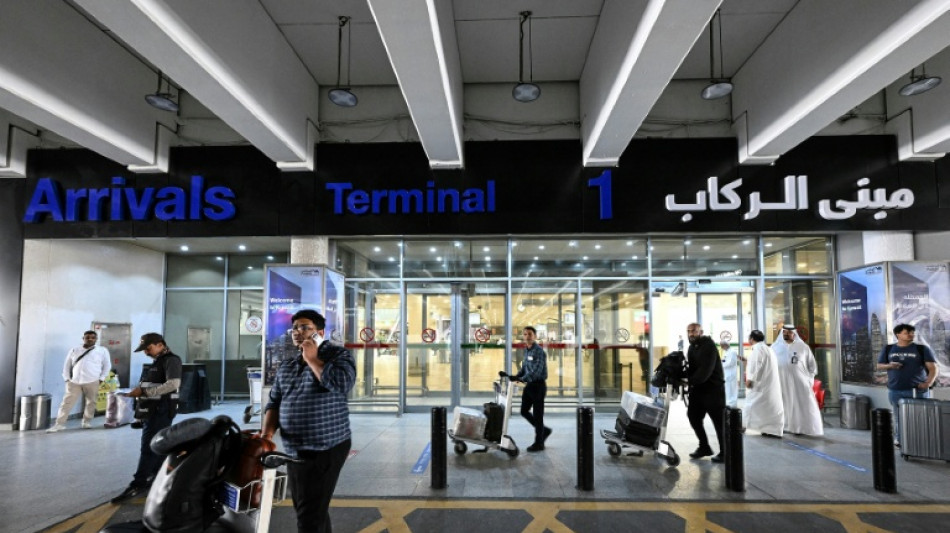
US embassies urge citizens to consider departing Middle East / Photo: YASSER AL-ZAYYAT - AFP
US embassies in capitals across the Middle East on Saturday warned American citizens to beware of an "unforeseen escalation" in the regional conflict and urged them to be ready to leave.
The warning, posted online by US embassies in Bahrain, Iraq, Israel, Jordan, Kuwait, Lebanon, Oman, Qatar, Saudi Arabia and the United Arab Emirates came a day after US President Donald Trump threatened to hit Iran "very hard".
Iran and the United States have been at war since February 28. A period of calm followed a ceasefire, though that collapsed with a return of strikes.
With no end in sight, the war has for months upended the lives of people across the Middle East and rattled global energy markets.
"Americans in the region should consider departing, or be prepared to depart should there be escalation," said the security alert.
The messages urged citizens to check flight details and to follow safety advice from local authorities.
"Americans currently in the Middle East should exercise caution and heightened vigilance and should be prepared for flight cancellations, periodic airspace closures, and potential travel disruptions," it said.
Americans in Jordan were told not to visit US military bases there, which have recently come under Iranian missile attack, and in Israel they were urged to seek the location of the nearest bomb shelter.
"The Iranian regime is unpredictable, as seen by its recent decisions to attack areas in the region without warning or provocations as well as to expand attacks to areas not previously targeted (such as Egypt)," said a post on the US Embassy Jerusalem site.
The US embassy in Beirut said that the mission remained on "ordered departure status", meaning that non-emergency US government personnel were still relocated outside of Lebanon.
- 'Defensive shield' -
Iran's military on Saturday accused Washington of "escalating tensions" in the region.
"Any country serving as defensive shield for criminal and aggressive America will be engulfed by the flames of war," Ali Abdollahi, head of Iran's military central command, said in a statement read on state television.
Mohammad Mokhber, adviser to Iran's supreme leader, also warned against any attacks on Iranian infrastructure.
"You calculate through military equations, but we respond with the logic of history," he wrote on X.
"Attacking Iran’s infrastructure directly awakens the fault lines on which 250 years of your hegemonic architecture have been built."
Iran and the US resumed overnight exchanges of fire last month after a days-long lull in fighting, although there were no reported strikes overnight Friday to Saturday.
On Wednesday a drone struck a US-owned gas vessel moored in an Egyptian port, causing a fire. Egypt is investigating but has not yet accused any group of launching the attack.
Meanwhile an "unknown projectile" struck a tanker off the coast of Oman, a British maritime agency said on Saturday, as the United States and Iran vie for control of the Strait of Hormuz.
Iran has effectively maintained control over navigation through Hormuz since the outbreak of the war on February 28, requiring vessels to obtain permission and pay transit fees before using the waterway.
Maritime trade tracking firm Kpler said on Friday that traffic through the Hormuz strait has dropped "sharply".
"With US and Iranian public positions still at odds, operators are closely monitoring traffic volumes, routing behaviour and any diplomatic developments that could reshape risk across regional shipping lanes in the days ahead," the firm said on X.
The Middle East war broke out when the United States and Israel launched strikes on Iran, which has retaliated with missile and drone strikes across the region.
On the Lebanon front, Israel's military on Saturday said it killed three Hezbollah fighters in southern Lebanon, while one of its soldiers was moderately injured during a "close-quarters encounter" with Hezbollah militants.
burs-dc/jfx/ser
E.Steiner--HHA