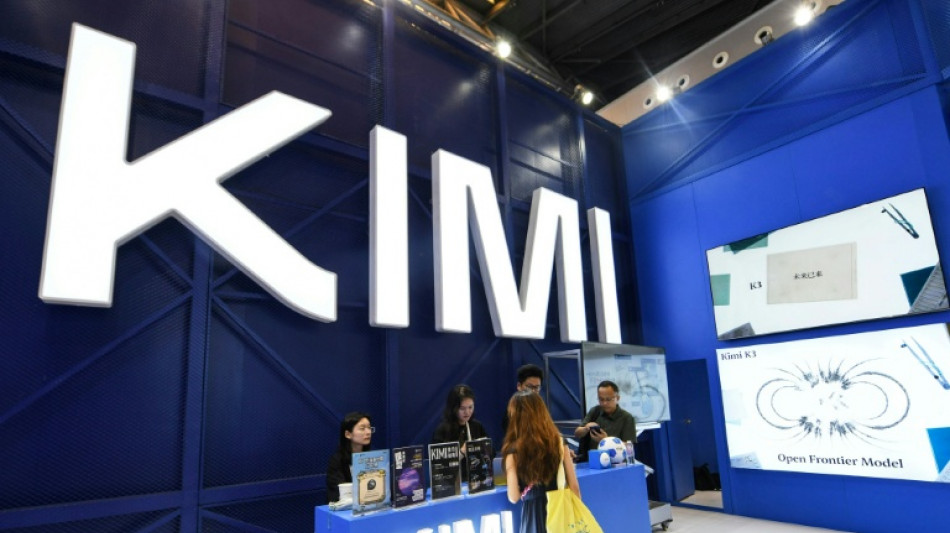
China's Kimi K3 rattles US AI industry / Photo: - - CN-STR/AFP
Kimi K3, a new artificial intelligence program from a Chinese startup called Moonshot AI, stunned the US tech industry on Friday, setting off fresh discussion over the China-US rivalry to dominate AI.
The program was released Thursday and within hours hit the top spot on a widely watched ranking of AI coding tools called Arena, marking the first time a Chinese model had claimed the number one position on the list.
Investors in Silicon Valley and on Wall Street, as well as White House officials, worry that if China can build AI as good as America can, then US companies like OpenAI and Anthropic may struggle to keep charging high prices for their products.
Kimi K3's release follows that of other much-hyped Chinese AI models. Like most of China's offerings, it costs less and uses source code that programmers can customize.
Some experts compared the moment to early 2025, when another Chinese company called DeepSeek shocked markets by releasing a powerful AI model at a fraction of the usual cost.
That episode briefly wiped hundreds of billions of dollars off the value of US tech companies.
- 'Reckoning' -
Anastasios Angelopoulos, who runs the Arena ranking site, told the TITV podcast that Kimi K3 could force investors to rethink the whole AI industry, since businesses may prefer free Chinese programs they can customize on their own computers over paid American ones that require sharing data with outside companies.
He said the release will likely "cause a reckoning in the capital markets" since it "brings into question what the dominance will be" of US-based, closed-source models like those from OpenAI and Anthropic.
David Sacks, a venture capitalist who advises the White House on AI and is a vocal opponent of tech regulation, said on X that Kimi's success showed US dominance was under threat and that the technology should be allowed to develop unimpeded.
He argued that American politicians are slowing their country down by blocking new data centers, adding state-level rules and pushing for a federal agency to approve powerful AI models before they can be released.
"This is how you lose the AI race," Sacks wrote.
Dean Ball, who recently worked as an AI adviser in the White House and now works at OpenAI, said Kimi K3 was clearly a strong program and not just a copy of American models, a frequent criticism of Chinese AI products.
He predicted President Donald Trump's administration will eventually try to more explicitly discourage US companies from using Chinese AI -- not by outright banning it, but by warning that it contains hidden risks and that companies should not use them.
"You just create enough regulatory risk that every regulated enterprise backs off," he wrote on X.
For Gavin Baker, a prominent Silicon Valley investor, Kimi K3 is "potentially negative for Anthropic and OpenAI while being net positive for essentially every other company in the world."
E.Mariensen--HHA