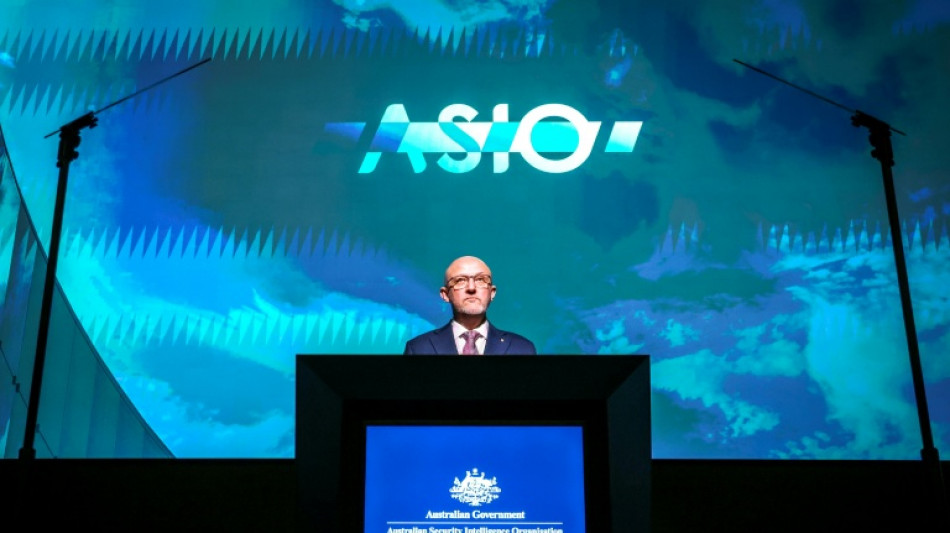
Australia spy chief warns of Iran terror threat / Photo: DAVID GRAY - AFP
An Australian citizen living in Iran who was a senior member of its Revolutionary Guards orchestrated a major antisemitic firebomb attack in Sydney, Australia's spy chief said Wednesday.
Giving an annual threat assessment, Mike Burgess, director-general of the Australian Security Intelligence Organisation (ASIO), said he was also concerned that an Iranian group active in Europe could conduct further attacks or an assassination in Australia.
ASIO has come under scrutiny after 15 people were killed in an antisemitic mass shooting at Bondi Beach in December, with an independent inquiry into antisemitism noting a drop in the share of funding for counter-terrorism investigations.
In his Canberra speech, Burgess defended the agency as it faced "concurrent, cascading, and compounding threats", and revealed details of investigations into two antisemitic firebombings traced to Iran.
An Iran-based Australian citizen orchestrated the 2024 firebombing of a Bondi restaurant, Lewis' Continental Kitchen, in the first major antisemitic attack in Australia, he said.
"This person is a senior agent of the IRGC Quds Force, running its networks around the world," he said, referring to the Guards' foreign operations branch.
A former Australian resident living in Iraq but working for Iran had directed another major firebomb attack, on the Adass Israel Synagogue in Melbourne, he said. Australia expelled Iran's ambassador last year over the attack.
- State hackers -
An Australian crime figure was arrested in January after pressure from Australian and Iraqi police.
"Iran recruited him through a complex web of Iraqi-based militia groups. Valuing his high wealth and criminal connections, the IRGC protected him and supported his illegal enterprises," Burgess said.
Iran continued to view Australia as a target, and could "conduct or inspire acts of arson, vandalism or even assassinations on Australian soil".
The Bondi Beach attack, allegedly by father-and-son killers, was shocking but not surprising in the context of a deteriorating global and domestic security environment, he said.
There were "misunderstandings" about how ASIO allocates resources, he added.
The number of officers working on counter-terrorism doubled between 2005 and 2025 and the agency was using new tools including artificial intelligence.
ASIO had foiled 31 major terrorism plots since 2014, and its cases had become more complex as people became radicalised in online chat rooms not prayer halls, within weeks, and at a younger age.
Burgess said state hackers had penetrated a critical infrastructure network, and outlined how a particular nation had sought to coerce eight people, including five Australians, to return to their place of birth to silence them.
Foreign spies were seeking to recruit Australians to reveal official secrets about AUKUS, the country's security partnership with Britain and the United States.
"What's more important: the liberty and agency of an individual, countering antisemitism, the availability of critical infrastructure or defending AUKUS? I don't believe we can prioritise the major threats -– you must deal with all of them," he said.
W.Widmer--HHA