'Make emitters responsible': Thailand's clean air activists / Photo: Lillian SUWANRUMPHA - AFP/File
A finance specialist who struggled after running in smog and a doctor who fears for the health of his children are among the activists spearheading landmark air pollution legislation in Thailand despite political uncertainty.
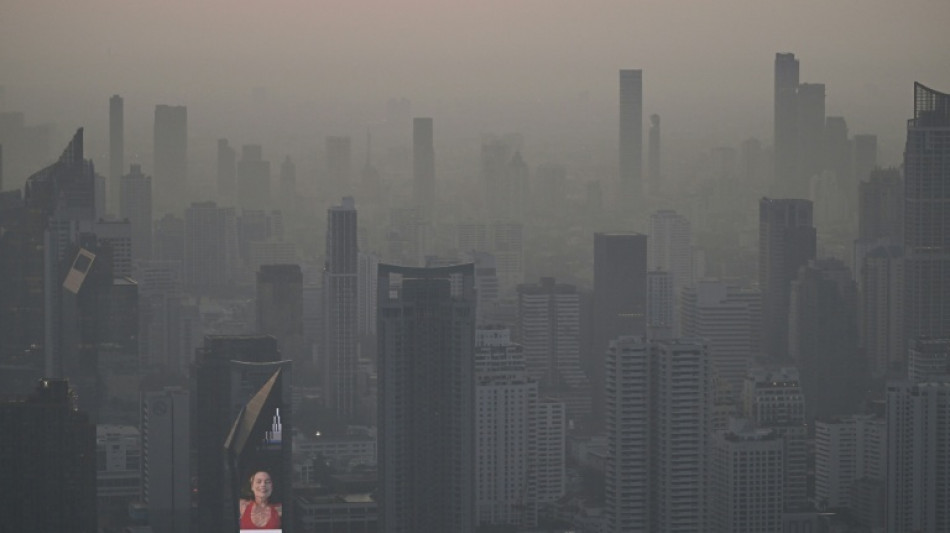
Each winter, large parts of Thailand are plagued by haze caused by weather patterns, seasonal burning, vehicle exhaust and industrial emissions.
Years of efforts to tackle the problem, including work-from-home policies and rules on crop stubble burning, have done little to alleviate the issue.
Now, there is a glimmer of hope for fresh action in the form of the Clean Air bill, which would enshrine the right to breathable air, tax emitters and offer public information on the sources of pollution.
Wirun Limsawart, who has helped lead the push for the measure as part of the Thailand Clean Air Network (CAN), grew up in southern Nakhon Si Thammarat.
But it wasn't until he returned to Thailand in 2018 after a decade abroad that he realised the scale of the country's pollution problem.
He began to worry about the impact of the dirty air on his three children.
"It made me question my role as an anthropologist and a doctor," he told AFP.
"What can I do?"
The son of a seamstress and a mechanic, Wirun was a straight-A student who studied at one of Thailand's top medical schools.
"My parents always showed me what it meant to genuinely care for others in their work, so that kind of embedded in me," the 49-year-old said.
"I chose a career path that allowed me to help people."
His life has been marked by illness.
In his early twenties, Wirun collapsed on a bus and was diagnosed with a brain tumour.
After chemotherapy and years of follow-up tests, the experience deepened his desire to better understand patients.
"My role was switched to become a patient... I wanted to genuinely understand patients from a doctor's perspective."
After eight years as a general practitioner in some of Thailand's poorest and most remote regions, he obtained a master's degree and PhD in anthropology at Harvard University.
He now works at the Ministry of Public Health as an anthropological doctor, blending medical research with studying human behaviour.
- 'My problem too' -
Wirun's pollution worries led him to a panel discussion in Bangkok on the issue in 2019, and the conversations evolved into CAN, which has spent several years advancing clean air legislation.
More than 20,000 people backed the group's call for action -- surpassing the threshold for public-initiated legislation -- and a draft bill passed the Thai parliament's lower house in October.
"We need to make emitters responsible," Wirun said.
But that goal is facing a new hurdle after Thailand's prime minister dissolved parliament this month, putting the bill on hold.
Still, the measure could be brought back after general elections early next year, if there is political will, according to Weenarin Lulitanonda, CAN's co-founder.
"In Thailand, and particularly in the very highly uncertain political environment, one of the things that Thais are certain of is a huge amount of uncertainty," she said.
"Right now, honestly, it's anyone's guess. We really don't know until general elections are held."
An outdoor run in 2018 drew Weenarin into clean air activism. The experience left her with a piercing headache she later learned was caused by Bangkok's seasonal smog.
More than 10 million people required treatment for pollution-related health problems in Thailand in 2023, according to the health ministry.
Weenarin had previously lived in New Zealand and never worried about air quality, but the more she looked into the issue, the more she was determined to do something about it.
"How is it possible that (in Thailand) someone has no information about what they are breathing?" she said, recalling the question that pushed her into activism.
Having studied finance and worked at the World Bank, Weenarin began contacting experts to understand the problem before helping establish CAN.
She said her motivation is simple: "If there were an alternative to breathing, I wouldn't care."
Clean-air reforms rarely start with governments or businesses, Weenarin said, and she worries too few Thais see the crisis as their problem.
"Don't vote for anybody who doesn't have clean air legislation as a key political manifesto and a commitment... follow them, become the political watchdog that we all need to be," she said.
She is determined to keep fighting though, so "enough Thais wake up and say this is my problem too".
H.Rathmann--HHA