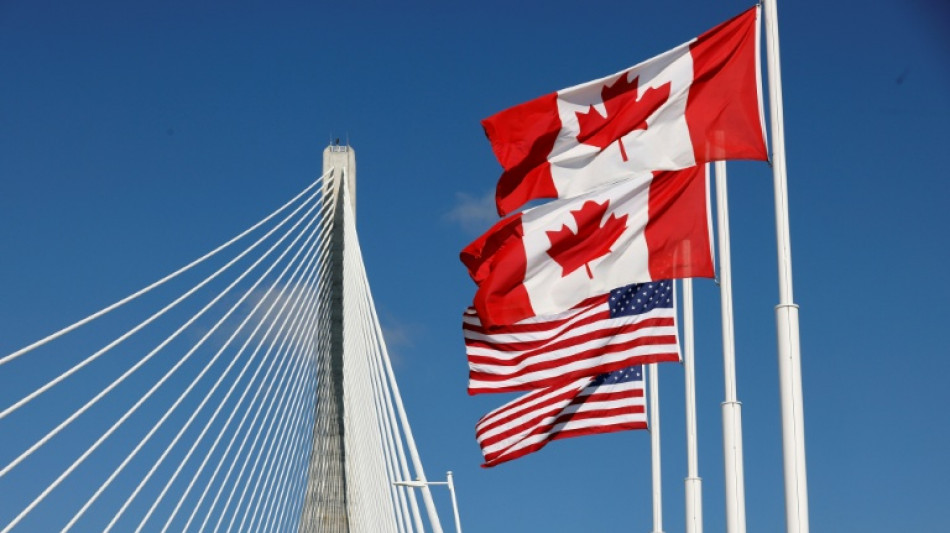
How hot can the US-Canada trade war get? / Photo: JEFF KOWALSKY - AFP
The US-Canada trade war has escalated rapidly, rupturing what was once one of the world's closest economic partnerships.
But the conflict is a mismatch, with the $31 trillion US economy roughly 13 times larger than Canada's, raising questions about the limits of Prime Minister Mark Carney's defiance.
Experts say if Carney sticks with targeted retaliation, the Canadian economy could endure with tolerable amounts of pain, as President Donald Trump confronts pushback from pockets of the American public.
- How far can Canada go? -
Canada's economic reliance on the United States is unique among advanced Western democracies, with roughly 75 percent of all Canadian exports heading south of the border before Trump returned to office last year.
Still, Carney had no choice but to turn down Trump's trade deal offer last month, despite the likelihood of retaliation, said Drew Fagan, an expert on Canada-US economic relations at the University of Toronto.
"It was a terrible offer," Fagan told AFP.
"If you don't have a deal that's possible, you have to walk away."
Carney's decision to suspend talks spurred Trump to implement a new round of levies, which Canada matched this week, prompting the president to announce more penalties on a range of Canadian products, from alcohol to dairy.
"So, the question (for Canada) becomes, 'what do you do in circumstances where the big guy ups the ante?'" Fagan said.
Carney needs to "think hard about his next move," Fagan argued, and ensure any new countermeasures are chosen strategically while recognizing Canada "is always going to be at a disadvantage."
Wendong Zhang, professor of applied economics and policy at Cornell University, noted that "Canada is the economy with the most to lose in every scenario."
Broad-based retaliation against the United States carries huge risks, Zhang said, but stressed "targeted retaliation is a different story," highlighting areas where Canada can deliver a marginal blow to the US with no impact on Canadians, like wine sales.
Senior TD economist Andrew Hencic said Wednesday that the bank believes "the likelihood of further Canadian escalation is low."
- Can diversification help? -
Reducing Canada's economic reliance on the United States has become Carney's top priority.
He has backed plans for a new pipeline to the Pacific coast to help get more oil to Asia.
But in terms of closer overseas partnerships, the European Union is Carney's main target.
The prime minister heads to Strasbourg, France, this month, where he will be the first head of any government to attend the "State of the European Union" address.
"Canada's relationship with the European Union has never been more important," Ottawa's EU ambassador Jonathan Wilkinson said last week.
"But the greatest opportunity lies ahead," Wilkinson added, citing critical minerals, clean industrial development and Arctic security as areas of potential cooperation.
Fagan said Carney's diversification strategy can work.
"It's not hyperbole to say the world wants what we have," he told AFP, calling diversification a "medium-term" strategy already paying dividends.
- Will escalation impact Trump? -
US Treasury Secretary Scott Bessent this week described Canada as a "yapping" little dog, picking a fight with a large German shepherd.
Trump has also argued that Canada is essentially irrelevant to the US economy.
But with the US midterm elections less than two months away, there is evidence of Canadian influence.
Maine Senator Susan Collins' reelection bid is seen as crucial to Republican hopes of keeping their Senate majority, but polls suggest she may lose.
This week she said the Trump administration had "very much underestimated" Canada's importance to Maine's business community.
Polls have also tightened in Kansas, long considered a safe Republican seat.
On Tuesday, Republican incumbent Senator Roger Marshall criticized Trump's threat to penalize Canadian plane maker Bombardier, which employs about 1,200 people in the state.
H.Graumann--HHA