Humanoid-maker Unitree surges more than 600% on Shanghai debut / Photo: Hector RETAMAL - AFP
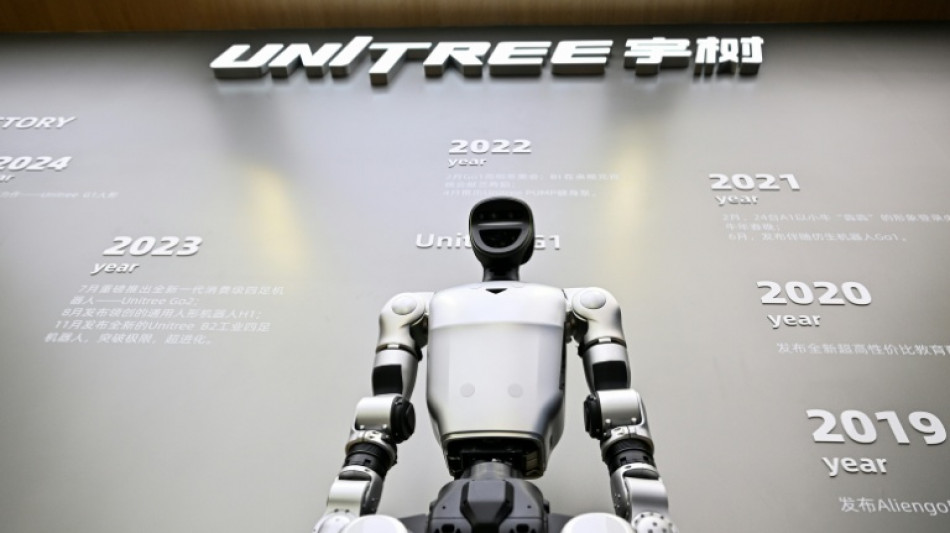
Chinese humanoid pioneer Unitree, whose backflipping robots wowed the world earlier this year, made a much-anticipated market debut in Shanghai on Wednesday with a similarly impressive leap in share price of more than 600 percent.
The Hangzhou-based firm's machines have become synonymous with China's push to develop its booming robotics industry, backed by government support and strong domestic supply chains.
It unveiled a new humanoid robot called "Superman" on Monday, touting it as able to jump as high as two metres and to run as fast as 12.66 metres per second -- faster than world record-holder Usain bolt if sustained over a 100 metres race.
It had previously drawn significant attention during China's annual Spring Festival gala performance last year, with its dexterous robots, wearing traditional Chinese vests, seen performing Kung Fu and jumping over tables.
On its debut Wednesday, the company's stock spiked as much as 629 percent to 1,100 yuan at the open, compared with its offering price of 150.80 yuan. They later pared the gains to around 830 yuan.
That was "the market firing a flare gun over China's next speculative frontier", Stephen Innes, global strategist at Quintex Intel, said.
"The message is pretty clear: embodied AI has become the new object of desire."
The IPO coincided with the opening day of the World Robot Conference in Beijing, where Unitree's booth was swarmed by dozens of visitors and reporters.
Many were taking selfies with a three-metre-tall Unitree GD01, a towering rideable robot the firm says can switch between bi and quadruped settings.
To its left, a small humanoid returned pingpong serves against a Unitree staffer, though the employee said the robot could not pick up the ball.
At the other side of the stall, eight robots danced to 1990s Chinese pop song "Lovebird".
- 'Underlying ecosystem' -
Commercial application of robots remains limited, with most used for research or display.
Unitree's products are used not just by domestic academics, but also US tech giants such as Nvidia, Google and Amazon, said Renjie Guo, founder and CEO of robotics engineering company Zeroth.
"It has formed the underlying ecosystem that enables many people to build their developments on top of Unitree," he told AFP.
Unitree has listed on the Shanghai Stock Exchange's tech-focused STAR market, often compared to the United States' Nasdaq.
Other Chinese humanoid robot firms such as the Shenzhen-based UBTech have listed in Hong Kong.
UBTech launched its "U1" robot -- equipped with eye cameras, chest sensors, and listening microphones -- earlier this year, touting the model as the world's first full-sized, ultra-realistic humanoid designed for mass production.
The Chinese government has designated robotics a strategic industry, and says that by last year, more than 140 Chinese companies had already launched more than 330 humanoid robot models.
Robotic companies have been ploughing resources into the development of physical AI -- technology that allows robots to move and interact with the world autonomously.
As the sector develops, it has become a new front in the US-China tech race, with domestic firms catching flak from countries like the United States.
Unitree was added to a list of firms Washington accused in June of aiding the Chinese military.
And in July, the Trump administration added humanoid and quadruped robots -- including from China -- to a list of products and companies that are banned from being imported into the United States on national security grounds.
Unitree's IPO is a "primary school graduation ceremony" moment for China's humanoid robotics industry, said Tianyu Zang, partner at Beijing-based venture capital firm Jinqiu Capital, which took part in Unitree's funding round last year.
"It is now finally ready to face a longer-term and more rigorous test," he told AFP, answering questions such as whether or not robots will soon be deployed in real-world scenarios.
"The industry will need to regularly present a public report card," he added.
M.Huber--HHA