South Korean stocks bounce after rout, oil holds gains on Mideast woes / Photo: Brendan SMIALOWSKI - AFP
South Korean stocks enjoyed a much-needed rally Thursday after a two-day rout as chip giant Samsung reported an eye-watering profit surge thanks to AI-driven demand, though the rest of Asia was mixed and oil held steep gains on fresh Middle East worries.
Seoul's Kospi has been hammered since hitting a record high last month and the painful sell-off in its chip giants SK hynix and Samsung echoed a global tech retreat as traders question the vast sums pumped into AI, and when or if they will see returns.
However, analysts point out that while the sell-off reflected concerns about the spending, the artificial intelligence sector remained solid.
Optimism got a boost Thursday as Samsung posted a 1,813 percent jump in second-quarter operating profit, buoyed by sustained AI-driven demand for memory chips.
It also said revenue surged 130 percent and net profit 1,300 percent. The results met expectations, South Korea's Yonhap news agency said, citing its own financial data firm.
Samsung's shares rose more than six percent Thursday, having dropped 16 percent Tuesday and Wednesday. SK hynix was flat following a 20 percent drop in the previous two days.
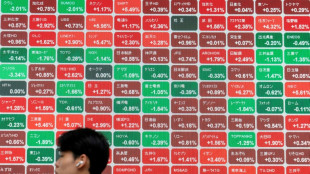
The Kospi rallied more than five percent in morning trade, while Tokyo -- which has also taken a beating in recent weeks owing to its heavy tech presence -- was up more than one percent. Hong Kong, Taipei and Jakarta rose.
The advances were helped by news from Microsoft that its cloud unit grew at the fastest pace in four years, though Facebook parent Meta posted a disappointing revenue forecast for the year.
Meanwhile, South Korea's government pledged to introduce measures to curb retail traders' access to leveraged exchange-traded funds, including limits on individuals' investment in them.
"Participants agreed that concentrated trading in single-stock leveraged products has contributed to heightened market volatility and pledged to respond swiftly and decisively," the finance ministry said in a statement.
Markets in Shanghai, Sydney, Singapore, Wellington and Manila were all down.
- 'Hitting them hard' -
Traders were left on edge after the US launched "powerful" strikes on Iran in retaliation for Tehran's attacks on US bases in Jordan as the Middle East war reignited and drew in the Islamic republic's proxies.
The first strikes after a nearly week-long lull in fighting dashed hopes of a return to negotiations.
Saudi Arabia and the United States also announced strikes Wednesday on militant bases in Iraq, while Israel accused Iran-backed Hezbollah of a truce violation.
Iran launched missiles at Jordan, with Iranian state media later reporting an American attack near its border with Iraq.
Earlier, US President Trump told Fox News: "We'll be hitting them hard...We are going to beat the 'effing s' out of them."
Oil prices, which had fallen at the start of the week as hostilities were paused, jumped Wednesday with Brent up more than eight percent.
While both main contracts slipped Thursday, the latest developments reinforced the fragility of any truce and the struggles officials face in reopening the Strait of Hormuz energy passageway.
Uncertainty about the Federal Reserve's plans for interest rates also weighed on sentiment after officials stood pat at their latest meeting but three policymakers dissented by calling for a hike.
The decision came amid fears about elevated inflation and the impact of the Middle East war on energy prices.
Bank boss Kevin Warsh said: "We are on the job. We will deliver. We are focused like a laser, making sure we can do it." He also cautioned there was "no magic wand" with which the Fed could lower inflation quickly.
"Despite three committee dissents in favour of a July hike, Chair Warsh stopped short of flagging an imminent hike, echoing June's tone," said IG's Fabien Yip.
"That is starting to unsettle investors: a Fed unwilling to commit to further tightening raises the question of whether it can keep long-term inflation expectations anchored."
And SPI Asset Management's Stephen Innes added that the dissents "were the more consequential signal".
"This was not a committee comfortably waiting for inflation to subside," he wrote.
"A quarter of its voting members believed the threshold for another increase had already been crossed, despite softer recent data, renewed geopolitical uncertainty and a sharp deterioration across several risk-sensitive markets."
Analysts said a spike in 30-year Treasury yields signalled traders were sceptical and the only way to get inflation back to the Fed's two percent goal was to hike rates.
- Key figures around 0250 GMT -
Seoul - Kospi: UP 2.5 percent at 5,806.49
Tokyo - Nikkei 225: UP 1.3 percent at 62,218.41 (break)
Hong Kong - Hang Seng Index: UP 0.1 percent at 25,817.85
Shanghai - Composite: DOWN 0.4 percent at 3,814.80
West Texas Intermediate: DOWN 1.1 percent at $83.55 per barrel
Brent North Sea Crude: DOWN 1.4 percent at $89.44 per barrel
Dollar/yen: UP at 163.49 yen from 163.47 yen on Wednesday
Euro/dollar: DOWN at $1.1452 from $1.1457 on Tuesday
Pound/dollar: DOWN at $1.3348 from $1.3350
Euro/pound: UP at 85.79 pence at 85.78 pence
New York - DOW: DOWN 2.2 percent at 51,594.14 (close)
London - FTSE 100: UP 0.3 percent at 10,908.41 (close)
Ch.Tremblay--HHA