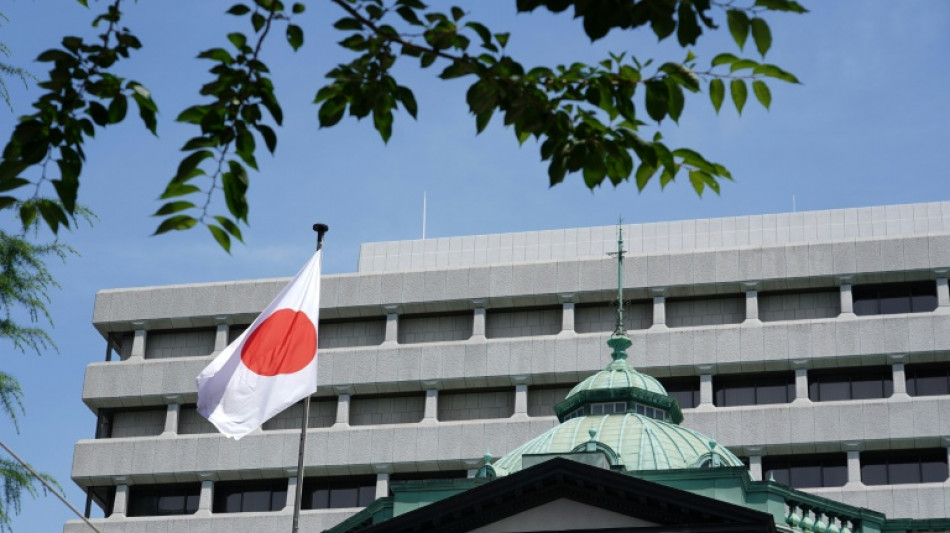
Bank of Japan hikes rate to 31-year high / Photo: Kazuhiro NOGI - AFP
The Bank of Japan hiked interest rates to a 31-year high Tuesday as it battles inflation caused by the Middle East war, even after Washington and Tehran agreed a peace deal.
The central bank for the world's fourth-largest economy raised its benchmark rate 25 basis points to 1.0 percent, the highest since 1995 and marking the first increase since December.
The widely expected decision followed rate rises by the European Central Bank and in Indonesia last week after the conflict caused economic havoc and rising prices worldwide.
With US inflation at a three-year high, expectations are growing that the Federal Reserve will follow suit, albeit not at new boss Kevin Warsh's first rate-setting gathering this week.
"While higher crude oil prices have been exerting downward pressure on economic activity, the economy has generally been supported by factors such as high levels of corporate profits and an improvement in the employment and income situation," the BoJ said.
The consumer price index (CPI) has been below two percent thanks in part to government energy subsidies.
"However, the price pass-through stemming from the rise in crude oil prices has been progressing at a relatively fast pace in business-to-business transactions, which could spread to an increase in consumer prices across a wide range of items," the central bank added.
"Against this backdrop, taking into account that medium- to long-term inflation expectations have also continued to rise, there is a risk of underlying CPI inflation deviating upward to a level above the price stability target of two percent."
Looking ahead, the BoJ said that it will "continue to raise the policy interest rate and adjust the degree of monetary accommodation".
"In this regard, it will consider the timing and pace of adjustment, while closely monitoring the impact of the future course ofthe situation in the Middle East on Japan's economic activity and prices," it said.
- US-Iran deal -
The United States and Iran have agreed to end their three-month Middle East war on all fronts and reopen the Strait of Hormuz, through which previously about a fifth of world oil passed.
The accord was set to be physically signed in Switzerland on Friday, but it will likely take considerable time for trade flows to return to pre-conflict levels.
Japan relied on the Middle East for around 90 percent of its crude supplies before the war began on February 28.
Its problems have been exacerbated by a falling yen, caused by the rise in oil prices and the gap between US and Japanese interest rates, which are among the lowest in the developed world.
The government spent around 11.7 trillion yen ($72 billion) last month propping up the currency, which has been languishing at around 160 yen against the dollar.
The yen briefly jumped against the dollar after the announcement on Tuesday, while the Nikkei 225 stock index rose above 70,000 points for the first time.
BoJ deputy governor Shinichi Uchida was slated to address the media on Tuesday afternoon after the rate decision, filling in for governor Kazuo Ueda, who is in hospital.
The central bank is under pressure from markets to keep tightening interest rates, but also from Prime Minister Sanae Takaichi's government not to put a brake on growth with high borrowing costs.
This could stoke dissent within the BoJ. Three of its nine board members voted against keeping rates unchanged at its previous meeting, and on Tuesday there was one vote against a hike.
hih-kh-jug-stu/abs
A.Wulhase--HHA