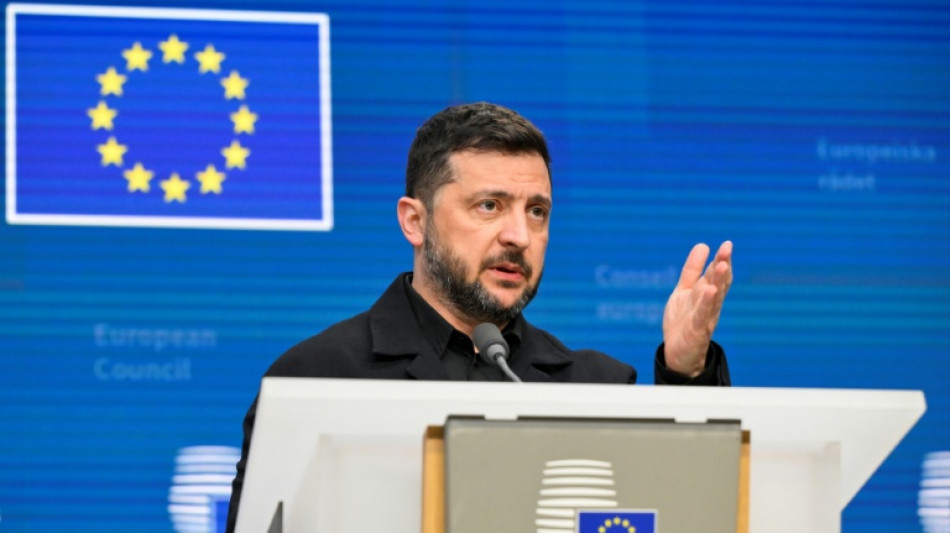
EU holds crunch summit on Russian asset plan for Ukraine / Photo: JOHN THYS - AFP
EU leaders gather in Brussels Thursday for a make-or-break summit on using frozen Russian assets for Ukraine -- with key player Belgium under pressure to drop its opposition.
The 27-nation bloc is scrambling to strengthen Kyiv's hand as Russia's war drags towards the four-year mark and US President Donald Trump pushes for a quick deal to end the fighting.
Officials have insisted the talks will last as long as it takes to hammer out an agreement, saying both Ukraine's survival and Europe's credibility are at stake.
"If we do not succeed in this, then the European Union's ability to act will be severely damaged for years," German Chancellor Friedrich Merz warned this week.
"We will show the world that we are incapable of standing together and acting at such a crucial moment in our history."
The EU estimates Ukraine, whose president Volodymyr Zelensky will join the meeting, needs an extra 135 billion euros ($159 billion) to stay afloat over the next two years -- with the cash crunch set to start in April.
In a bid to plug the yawning gap, the European Commission, the EU's executive, has put forward a plan to tap some 210 billion euros of Russian central bank assets frozen in the bloc.
The scheme -- which would initially provide Kyiv 90 billion euros over two years -- involves an untested financial switcheroo under which the funds are loaned to the EU, which then loans them on to Ukraine.
Kyiv would then only pay back the "reparations loan" once the Kremlin coughs up for all the damage it has wrought.
- Belgium blocking -
Belgium, where international deposit organisation Euroclear holds the vast bulk of the funds, has been firmly opposed due to fears it could face crippling financial and legal reprisals from Moscow.
Russia has already fired a shot across the bows by announcing it was suing Euroclear.
Belgium's outspoken prime minister Bart De Wever will be in the spotlight as his EU counterparts -- most of whom back the plan -- try to cajole him to accept.
EU officials say they have gone out of their way to allay Belgian worries and that multiple layers of protection -- including guarantees from other member states -- mean the risks are minimal.
But so far Flemish nationalist De Wever has only dug in further, insisting that any guarantees must be unlimited and assets frozen in other countries should be used too.
In theory, other EU countries could override Belgium and ram the initiative through with a weighted majority but that would be a nuclear option that few see as likely for now.
"These are complex decisions that cannot be forced," said Italian premier Giorgia Meloni, who could offer key political cover for Belgium.
- Plan B? -
The commission has floated a potential fallback plan of the EU raising the money itself to lend Ukraine.
But officials say that scheme has been shelved as it requires unanimous approval from the EU's 27 leaders and Hungary has ruled it out.
De Wever nonetheless looks set to try to revive that idea, and other countries may be open to his arguments.
"It is on the shelf, not in the bin," said one EU diplomat, speaking like others on condition of anonymity. "But we are focused now on the reparations loan."
Bubbling close to the surface of the EU's discussion are the US efforts to forge a deal to end the war.
Ukraine has said Washington was "pressuring" the EU not to use the assets as they view them as a vital bargaining chip in winning over Russia.
But EU officials deny that and say that, if anything, the push for peace has spurred the efforts to tap the Russian funds.
Given that Ukraine has only months before the shortfalls bite, diplomats and officials insist leaders will find a way to keep funds flowing -- even if this week yields only a loose deal with details to be hammered out later.
"We need to find a solution," said a second EU diplomat. "I'd be surprised if they break up on Saturday or Sunday without a decision."
A.Baumann--HHA


