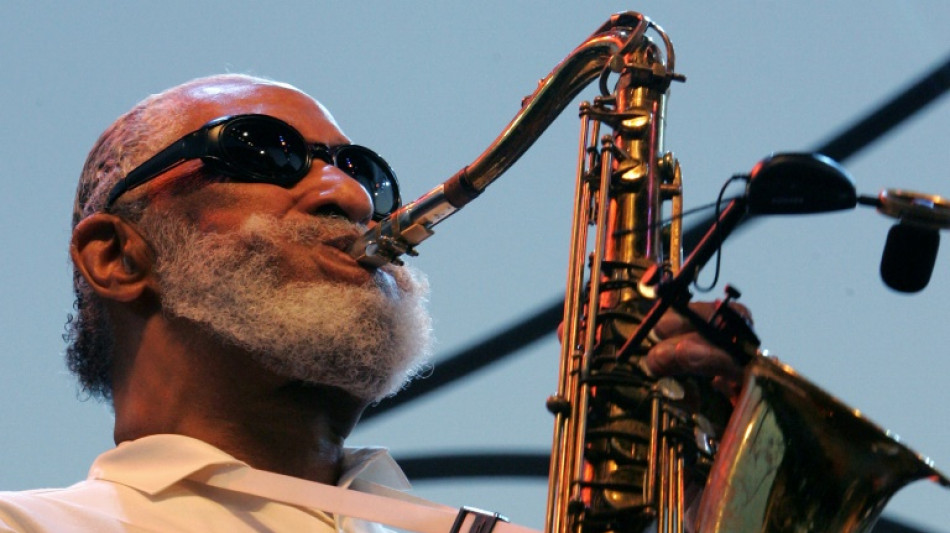
Sonny Rollins, last jazz 'colossus,' dead at 95 / Photo: PASCAL GUYOT - AFP/File
Sonny Rollins, the "Saxophone Colossus" whose hard-charging yet flowingly meditative works made him the last in a golden era of jazz greats, died Monday. He was 95.
"It is with deep sorrow and profound love that we announce the passing of Sonny Rollins," a post to his social media page said, adding that he "died this afternoon at his home in Woodstock, NY."
A constantly evolving creative force, Rollins found in jazz a means of social and spiritual commentary, with his tenor sax expressing the hopes of African Americans in the civil rights movement, the grief of the United States after the September 11 attacks, and the mystical path he found on extended retreats in India and Japan.
The Harlem-born Rollins -- recognizable in his later years for a shock of white hair -- was one of a handful of saxophone players who defined the instrument, a pantheon that includes Charlie Parker, Coleman Hawkins and John Coltrane, with whom he had an affectionate but complicated relationship.
But unlike so many artists from jazz's defining post-World War II period, Rollins lived a long life, remastering his work well into his 80s even as respiratory issues limited his performances.
In an interview with AFP, Rollins credited his longevity to yoga -- which helped him to concentrate and stay off drugs and alcohol -- but mostly to his creative thirst.
"I'm still alive because I'm still learning," Rollins said in the 2016 interview.
Among major saxophonists, Rollins' style was among the most biting -- a heavy delivery that often struck rather than soothed the listener -- yet he paradoxically was intricate and holistic about composing, describing music as a path to find universal truths.
He was dubbed the "Saxophone Colossus" after the title of his seminal 1956 album, in which he brought a new power to the instrument as he came to define hard bop -- a jazz that was intense and stripped back the genre's structural confines.
The most enduring image of Rollins comes from the early 1960s when, needing a break from his rising fame, he would practice on the Williamsburg Bridge that connects Brooklyn and Manhattan's bustling Lower East Side, playing for nearly every waking hour over three years, even in the cold.
The very public sabbatical produced one of his best-known albums, 1962's "The Bridge," and has led to proposals to rename the Williamsburg Bridge in Rollins' honor.
Rollins also crossed over to a non-jazz audience with occasional forays into rock, most notably his appearances on The Rolling Stones' 1981 album "Tattoo You."
- Childhood of discovery -
Born to parents who moved to New York from the US Virgin Islands, Rollins incorporated some of the inflections of his heritage into his jazz.
"St. Thomas," which appeared on "Saxophone Colossus" and became his best-known song, incorporated Caribbean calypso that he had heard as a child.
Raised in Harlem, the epicenter of African American culture, Rollins recalled that his early musical education came from the Apollo Theater where he would watch its celebrated amateur nights.
By his 20s, Rollins had already managed to play with jazz legends including Parker, Miles Davis and especially Thelonious Monk.
The young Rollins would hang out at Monk's apartment and played on the pianist's classic 1957 album "Brilliant Corners."
Coltrane's relationship with Rollins has often been described as one of rivalry. Both explored new directions in jazz and became fascinated with Indian spirituality.
Whereas Coltrane brought grace and a gentle texture, Rollins arguably delivered a firmer sense of music's ebbs and flows, crafting jazz in the manner of a classical composer.
Coltrane, who died of cancer in 1967, is only known to have recorded once with his contemporary, on the title track of Rollins' 1956 album "Tenor Madness."
Rollins, reflecting on his nearly seven-decade career in the 2016 interview with AFP, said he had perhaps been too brash with the legends around him.
"I look back on my relationship with Coltrane, and my relationship with Monk -- a lot of stupid things I did with those people that I would not have done if I was more mature," said Rollins, who called Coltrane "a beautiful, beautiful human being."
Rollins' manager and wife of nearly 40 years, Lucille, died in 2004.
- Sax 'from subconscious' -
Rollins followed "Saxophone Colossus" with 1957's "Way Out West," in which he introduced his technique of "strolling" -- saxophone solos that would flow over drum and bass, without the piano chords that traditionally kept jazz ensembles in key.
"When I play and I improvise, I don't think, because music comes from the subconscious, someplace else," Rollins told news site The Root.
"I'm just a human, so when I play my horn, I get into a state where the music plays me. I'm just standing up there and fingering my horn and blowing," he said.
Rollins embraced yoga, finding that the breathing techniques and especially the concentration gave him a new fluency with his instrument.
In a sequel to his Williamsburg Bridge years, Rollins took a second sabbatical starting in 1966, learning Zen meditation in Japan before spending several years in an ashram in India, where he arrived with just a bag and his saxophone.
Under the guidance of Swami Chinmayananda on the outskirts of Mumbai, Rollins devoted his days to reading and discussing sacred Vedic texts. He rarely performed, although he later brought his spiritual quest into his music in compositions such as "Patanjali," named for the great yoga master.
Jazz artists "were trying to find a way to express life through our improvisations. The music has got to mean something," Rollins later told National Public Radio.
- Bold civil rights statement -
Rollins found a new purpose to music with "Freedom Suite," his 1958 work that spoke to the rising struggle of African Americans for equal rights.
If musically the 20-minute instrumental piece reflected Rollins' artistic freedom in the abstract, he made no secret of its political bent, penning a message in the liner notes that was strikingly bold for an artist of the era.
"America is deeply rooted in Negro culture: its colloquialisms; its humor; its music. How ironic that the Negro, who more than any other people can claim America's culture as his own, is being persecuted and repressed; that the Negro, who has exemplified the humanities in his very existence, is being rewarded with inhumanity," he wrote.
"Freedom Suite," led by Rollins' confident sax and also notable for Max Roach's drumming, proved controversial enough that a reissue chose another title for the album. Rollins recalled that he was confronted about the piece when he performed in the US South.
Rollins similarly championed Black pride on "Airegin," another of his best-known pieces which is rigorously quick-paced -- and whose title is an anagram for Nigeria.
Rollins found another purpose to his art after the September 11, 2001 attacks, when he was living just six blocks from the doomed World Trade Center. He had to walk down 40 flights of stairs to evacuate his building and felt ill from the fumes.
Nonetheless, Rollins played four days later in Boston -- driving there as flights were grounded -- for a concert that became a live album of remembrance to victims of the attack.
Rollins recalled feeling a sort of serenity as he returned to New York, finding a new empathy in the metropolis.
But Rollins, who later moved to a farm in upstate New York where he had space to meditate, would grow pessimistic at humanity's prospects.
Rollins said that, in the 1960s, he and other artists felt that music could bring peace to the world.
"But then I learned, and I lived a little longer," he told AFP.
"I realized that this world will never change. This world is meant to be a place of war, killing, everything -- sickness, illness, death. That's this world."
E.Borstelmann--HHA