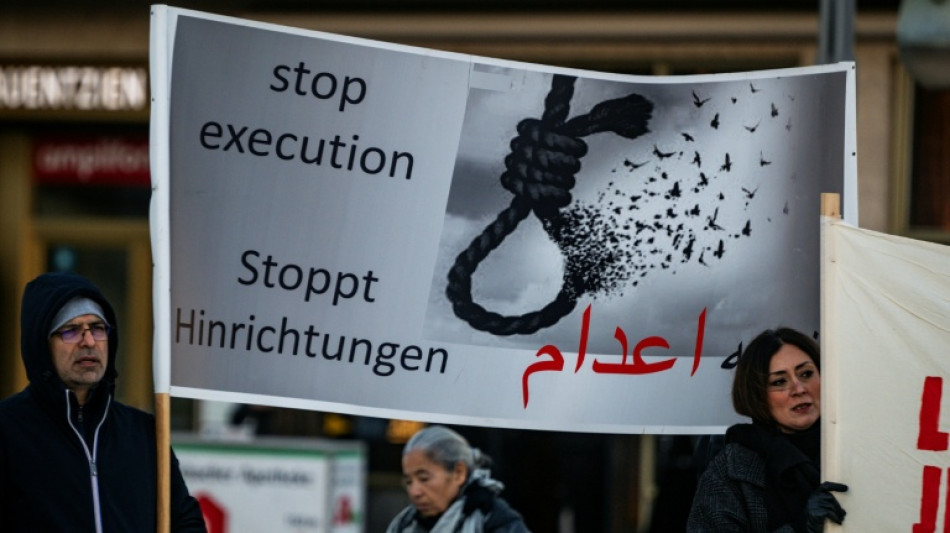
Iran hangs two 'political prisoners' from banned opposition: activists / Photo: John MACDOUGALL - AFP
Iran on Monday hanged two men who were members of a banned opposition group and described by rights groups as political prisoners, as Tehran keeps up executions against the background of the war against the US and Israel.
Akbar Daneshvarkar, 60, and Mohammad Taghavi-Sangdehi, 59, were hanged at dawn in the notorious Gehzel Hesar prison in the Tehran satellite city of Karaj for membership of the outlawed People's Mujahedin of Iran, also known as Mujahedeen-e-Khalq (MEK).
They were executed "after confirmation and final approval of the sentence by the Supreme Court", the judiciary's Mizan Online website said.
The MEK opposed the rule of the shah and initially supported the 1979 Islamic revolution but rapidly fell out with the new clerical leadership in the 1980s. It is now based in exile and is designated as a terrorist organisation by Tehran.
The group's political wing the National Council of Resistance of Iran (NCRI) in a statement confirmed that the two were members of the MEK.
Its leader Maryam Rajavi said "the desperate clerical regime, in fear of the people's uprising, vainly attempts to delay the explosion of the people's anger for a short while by executing the bravest children of Iran."
- 'Severe internal repression' -
Campaign groups have long expressed fear that there will be a new surge in executions as authorities use capital punishment to spread fear throughout society against the background of the now over month-long war against Israel and the US.
"We fear that the Islamic republic will exploit the current wartime conditions to carry out mass executions inside prisons, to instill societal fear," said director of Norway-based NGO Iran Human Rights Mahmood Amiry-Moghaddam.
IHR said the two "political prisoners" were "subjected to physical and psychological torture, denied due process rights and sentenced to death in a process that did not meet minimum fair trial standards."
It warned four co-defendants are "at grave and imminent risk of execution" in Ghezel Hesar prison after being sentenced to death in the same case.
Shadi Sadr, co-founder of the NGO Justice for Iran, which seeks legal accountability for rights violations in the Islamic republic, said "the Iranian people are trapped between an international war and severe internal repression."
Mizan said the two executed men were charged with participating in "terrorist acts", carrying out actions aimed at overthrowing the Islamic republic, and disrupting national security.
According to the NCRI, the MEK regularly carried out actions inside Iran aimed at the clerical authorities.
Iran on March 19 executed three men who were accused of killing police officers during protests in January, the first hangings Iran has carried out related to the nationwide demonstrations that were met with a brutal crackdown by the authorities.
One of them was teenager Saleh Mohammadi, who had only just turned 19 and had taken part in international wrestling competitions.
Iranian authorities also in March executed Kouroush Keyvani, a dual Iranian-Swedish national, on charges of spying for Israel, in a hanging strongly condemned by Stockholm and the EU.
Iran is the world's most prolific executioner after China, according to rights groups. Last year it hanged at least 1,500 people, according to figures from IHR.
F.Fischer--HHA